


Avoiding cloud skills feels safe right up until the moment it doesn’t. Nothing dramatic happens along the way. Your job still exists, your manager still says good things in review season, and the systems you know inside out keep running exactly as they always have. But while you were busy being excellent at yesterday’s stack, the market quietly moved the goalposts, and you’ve been paying for it ever since, in ways that never show up on a payslip.
Call it the comfort zone tax. Like any tax, it gets collected whether you notice it or not. It comes out of your salary growth, your shortlist rate, your project exposure and your bargaining power. In this guide we itemise the bill, explain why capable people keep paying it, and lay out a realistic 90-day plan to stop, whether you work in Sydney, Melbourne, Brisbane, Perth, Adelaide or Canberra.
What Does Avoiding Cloud Skills Actually Look Like?
It rarely looks like refusal. Nobody announces, “I will not learn Azure.” Avoidance is quieter and far more reasonable-sounding. It’s the AZ-900 module you bookmarked in March and never opened. It’s the “we’re mostly on-prem anyway” comment in a team meeting. It’s volunteering to clear the legacy ticket queue so somebody else gets the migration workstream. Each choice is defensible on its own. Together they form a pattern, and patterns are exactly what recruiters read when they scan a resume.
Microsoft Azure is no longer a side-skill sitting next to the “real” infrastructure work. For many Australian employers, from federal agencies in Canberra to financial services teams in Sydney and resources companies in Perth, Azure, Microsoft Entra ID and hybrid environments are the real infrastructure. The gap doesn’t announce itself because it’s measured against a baseline that keeps moving.
The Hidden Bill: Six Ways Avoiding Cloud Skills Costs You

Here is the itemised version. Not every cost lands on every person, but these six show up again and again across IT careers in Australia.
1. Slower salary growth
Employers pay a premium for skills that are scarce and tied to systems the business can’t live without. When your daily work is confined to tooling the organisation is gradually replacing, your case for a meaningful raise gets harder to make. That isn’t because you work less hard. It’s because the work is worth a little less to the company next year than it was last year. Over five or ten years, even a modest annual gap compounds into a very real number.
2. A shrinking shortlist
Applicant tracking systems and recruiters filter on keywords before a human reads a single sentence. If “Azure”, “Microsoft Entra ID”, “Infrastructure as Code” or “Azure Monitor” never appear on your resume, you can be an outstanding engineer and still be invisible. The cost of avoiding cloud skills here is silent: you never receive a rejection email for the roles you didn’t make the pile for. We unpack this effect in our article on the cloud career paradox.
3. Missing the migration projects
Cloud migrations are where careers get made. They’re visible, cross-team and tied to business outcomes. Professionals who spend years avoiding cloud skills get routed to maintenance work, while colleagues with even a foundation certification get pulled into design workshops, landing zone planning and cutover weekends. Exposure becomes experience, and experience becomes the next role.
4. A weaker negotiating position
Negotiation is leverage, and leverage is options. If your only realistic employers are the ones still running everything on-premises, you have fewer choices and everybody at the table knows it. If you can credibly work across Azure, hybrid and traditional infrastructure, the conversation changes completely.
5. Becoming easier to replace
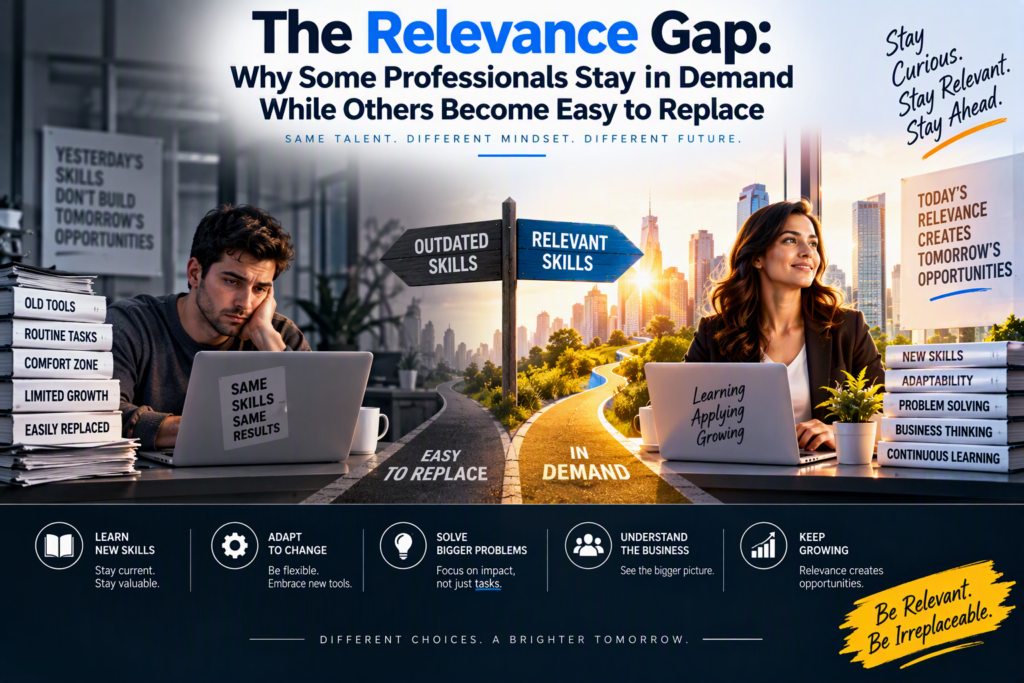
This is the uncomfortable one. From a workforce-planning perspective, a professional who understands only legacy systems is a transitional cost. A professional who can bridge legacy and cloud is a transition asset. Same years of experience, very different risk profile when budgets tighten. Our piece on the relevance gap explores why some professionals stay in demand while others become easy to replace.
6. A learning gap that compounds
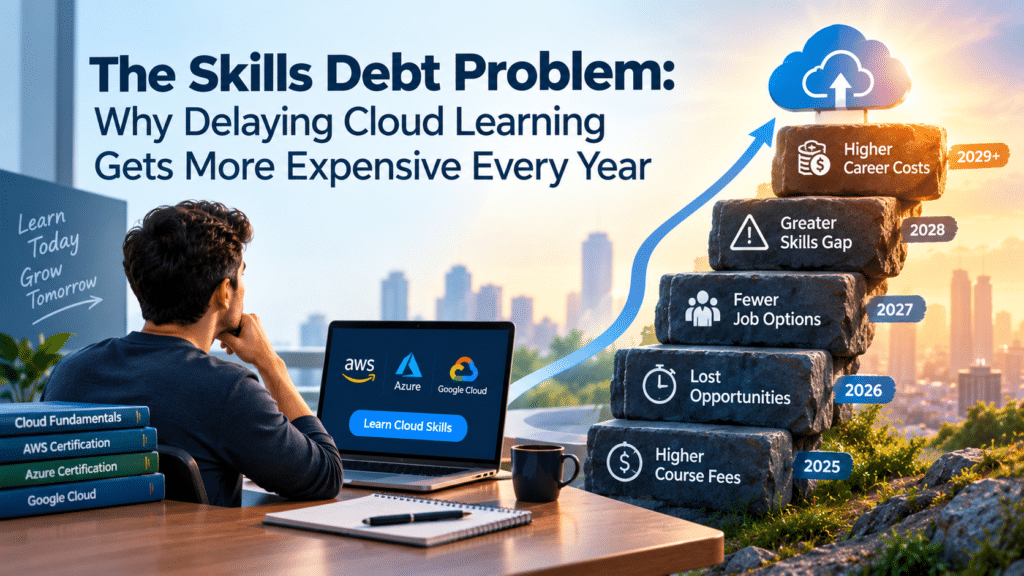
The longer you wait, the more there is to catch up on: new services, new security models, new AI integrations such as Azure OpenAI. Each year of delay doesn’t add one year of catch-up. It adds a year of change on top of the existing backlog. We’ve mapped that arithmetic in our guides on the cost of waiting to learn Azure and on the wider cloud skills gap.
Why Smart People Keep Paying the Comfort Zone Tax
The professionals who end up avoiding cloud skills aren’t lazy. Very often they’re the most dependable people on the team, which is exactly why they’re too busy keeping today’s systems alive to learn tomorrow’s. Behavioural economists call the pull of the familiar status quo bias: the tendency to stick with what we know even when a better option is within reach. The table below shows the five excuses we hear most, and what each one really costs.
| The excuse | What it really costs | A better move |
| “I’m too busy right now” | The backlog grows while the workload never shrinks. | Protect two hours a week and start with a Fundamentals course rather than a full syllabus. |
| “My employer isn’t on the cloud” | Your next employer probably is. | Treat cloud skills as portable career insurance, not a requirement of your current role. |
| “Certifications are just paper” | Unverified skills lose to verified ones at the shortlist stage. | Pair the certification with a small hands-on project you can talk through in an interview. |
| “AI will change everything, so I’ll wait” | AI workloads run on cloud platforms, and you can’t secure or govern what you don’t understand. | Learn the platform first. Azure AI services sit on top of the same foundations. |
| “I’m too senior to start with the basics” | Senior people with cloud fluency are among the hardest to find. | Skip ahead to AZ-104 or AZ-305 if you already have deep infrastructure experience. |
What the Australian Market Is Signalling
The wider data points in one direction. ACS’s Digital Pulse 2026 report, prepared with Deloitte Access Economics, projects that Australia will need around 259,000 additional technology professionals by 2035, and estimates that digital skills across the broader workforce contributed about $476 billion to the economy in 2025. The same research found that the national technology workforce slipped slightly for the first time on record, to roughly 967,000 people.
Read those findings together and the picture is clear: demand for capable digital professionals is rising, supply isn’t keeping pace, and the people who benefit most are those whose skills match what organisations are actually building. If you want occupation-level detail, Jobs and Skills Australia publishes labour market analysis you can check for yourself.
A skills shortage, however, doesn’t mean any certificate guarantees a job. Employers want people who can do the work. That’s why we always recommend pairing training with labs and a project you can explain, a point we cover in depth in our article on why Azure certification jobs don’t arrive with the exam result. It’s also why choosing the right path matters, as we explain in why smart professionals choose the wrong certification path.
One more practical tip: Microsoft publishes its full role-based framework on Microsoft Learn, so you can see exactly which exam maps to which job role before spending a cent.
How to Stop Avoiding Cloud Skills: A Practical 90-Day Plan
You don’t need to quit your job or study every night. You need a sequence and a deadline. Here is a plan that works alongside a full-time role.
| Phase | Focus | What you do | Outcome |
| Days 1 to 30 | Foundations | Complete AZ-900 Azure Fundamentals training. Open a free Azure account and explore the portal, resource groups and pricing tools. | Shared vocabulary and early momentum |
| Days 31 to 60 | Hands-on practice | Build a small environment: a virtual network, a virtual machine, role-based access control and Azure Monitor alerts. Begin AZ-104 Azure Administrator preparation. | Lab evidence you can describe in an interview |
| Days 61 to 90 | Proof and visibility | Update your resume and LinkedIn with specific Azure services. Document one project. Apply for one stretch role or volunteer for an internal cloud initiative. | Skills that are searchable and discussable |
By day 90 you won’t be a cloud architect. You will, however, have stopped being invisible to cloud-related searches, and that’s the point where the comfort zone tax starts to reverse.
Which Azure Course Fits Your Starting Point?
The right entry point depends on where you are today, not where you think you should be. Use this table as a starting guide, or review our full Azure certification roadmap and certification comparison for more detail.
| If you are… | Start with | Why it fits |
| New to cloud or moving from a non-technical role | AZ-900 Azure Fundamentals | Plain-language grounding in cloud concepts, core services, pricing and governance. |
| A sysadmin, service desk lead or infrastructure engineer | AZ-104 Azure Administrator | Maps the skills you already have onto Azure operations, identity and monitoring. |
| A security or compliance professional | AZ-500 Azure Security Technologies | Covers identity, network and data protection in Azure. Pair it with Logitrain cybersecurity courses. |
| A software developer | AZ-204 Azure Developer | Focuses on building, deploying and monitoring cloud applications. |
| A senior engineer moving toward design | AZ-305 Azure Solutions Architect | Builds design skills across governance, identity, data and business continuity. |
| A network specialist | AZ-700 Azure Networking | Deepens hybrid connectivity, routing and network security skills. |
| An automation or DevOps practitioner | AZ-400 DevOps Solutions | Covers pipelines, infrastructure as code and release management. |
You can also browse every pathway on our Azure certifications hub or explore the wider range of Microsoft Azure courses at Logitrain.
Azure Training for Avoiding Cloud Skills Regret: Sydney to Perth
Where you live shouldn’t be the reason you stay put. Instructor-led and live online options are available across the country, and each city has its own flavour of demand:
- Sydney: large enterprise and financial services teams that increasingly run hybrid Azure estates. See Azure certification training in Sydney.
- Melbourne: a deep mix of healthcare, retail, education and technology employers. See Azure certification training in Melbourne.
- Brisbane: growing infrastructure, public sector and services demand. See Azure certification training in Brisbane.
- Perth: resources and energy organisations modernising operational and corporate systems. See Azure certification training in Perth.
- Adelaide: state government, defence and advanced manufacturing projects. See Azure certification training in Adelaide.
- Canberra: federal government agencies with strict security and governance requirements. See Azure certification training in Canberra.
Not sure which city option suits your schedule? Our locations page lists every delivery option.
Frequently Asked Questions About Avoiding Cloud Skills
Is avoiding cloud skills really risky for an IT career in Australia?
For most roles, yes, though the risk builds slowly. Demand is shifting toward professionals who can work across cloud and hybrid environments, and employers increasingly screen for cloud keywords. You can still build a good career in specialised on-premises work, but the number of employers who need it is narrowing.
Do I need to learn AWS and Google Cloud as well as Azure?
Not to begin with. Core concepts such as virtual networks, identity, storage and monitoring transfer between platforms. Starting with one platform and going deep is usually more valuable than skimming three. Azure is a sensible choice given how widely Microsoft technology is used across Australian businesses and government.
How long does it take to become Azure certified?
It depends on your background and study time. Many people with an IT foundation prepare for AZ-900 within a few weeks, while role-based exams such as AZ-104 typically need more hands-on practice and a longer runway. Structured, instructor-led training helps keep that timeline predictable.
Can I learn Azure while working full-time?
Yes. Most of our learners do. Short, consistent study blocks plus a few practical labs a week are more effective than occasional marathon sessions. Live online delivery also makes it easier to fit training around work.
Is Azure certification worth it if my employer doesn’t use the cloud?
It’s worth considering precisely because of that. Cloud skills travel with you, and they put you in a stronger position if your employer starts a migration or you decide to move on.
Stop Avoiding Cloud Skills Before the Tax Compounds
The honest summary is that the cost of avoiding cloud skills is rarely one catastrophic event. It’s a thousand small leaks: a raise that didn’t happen, a shortlist you never saw, a project that went to someone else. The good news is that the comfort zone isn’t a trap. It’s a habit, and habits respond to a plan.
Pick one course, one start date and one first lab. If you’d like help choosing, call our team on 1300 649 299 or send an enquiry and we’ll map your current role to the right Azure pathway, whether that’s AZ-900, AZ-104 or something further along the Azure certification roadmap.