


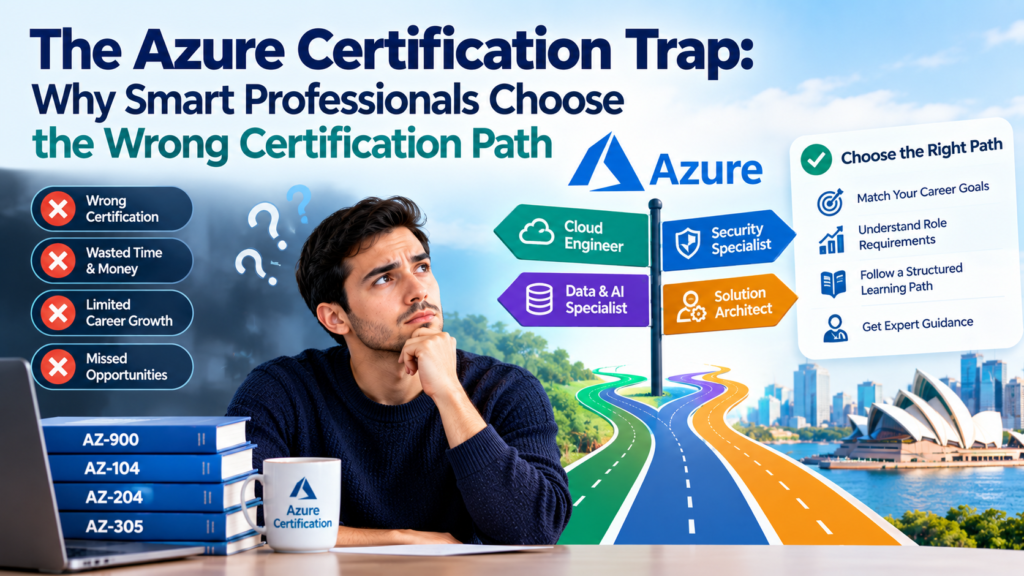
Every year, thousands of capable IT professionals in Australia enrol in an Azure certification path with genuinely good intentions and still end up with a credential that does almost nothing for their career. This is the Azure certification trap: a pattern where smart, motivated people choose the wrong Azure certification path not because they lack ability, but because they follow the wrong signals. They chase the exam with the biggest reputation, copy a colleague’s choice, or follow a generic “top certifications” list instead of mapping the certification to their actual role, experience level, and career goals.
If you have ever wondered why a colleague with three Microsoft badges is still struggling to land interviews, or why your own Azure certification path feels like it is going nowhere, this article breaks down exactly how the trap works and how to avoid it.
What Is the Azure Certification Trap?
The Azure certification trap happens when a professional treats certification as the goal itself, rather than as one part of a broader Azure certification path built around a real job outcome. Microsoft’s certification system is role-based by design: each exam maps to a specific job function, from cloud administration to security engineering to solutions architecture. When people skip that mapping step and simply pick whichever exam sounds impressive, they end up with a certificate that is technically valid but strategically useless for the role they actually want.
It is easy to fall into, because on the surface every Azure certification looks like progress. The trap is subtle: the study time is real, the exam fee is real, the badge on LinkedIn is real but the career impact is missing because the certification was never aligned with a job description, a skills gap, or an employer’s hiring criteria in the first place.
Common Mistakes That Push Professionals Into the Wrong Azure Certification Path
1. Chasing the Certification With the Biggest Name
Exams like AZ-305 or AZ-500 sound senior and impressive, so many candidates jump straight there. But an expert-level exam assumes years of hands-on Azure experience. Attempting it too early usually means months of theoretical cramming with little practical retention and a certificate that recruiters quietly discount once the interview reveals the experience isn’t there yet.
2. Ignoring Your Actual Job Role
A support desk technician, a data analyst, and a DevOps engineer need three completely different certification paths. Choosing based on “what sounds good” instead of “what my role or target role actually requires” is the single biggest driver of the Azure certification trap. The right question is never “which Azure certification is best?” it’s “which Azure certification matches the job I’m trying to get?”
3. Skipping Azure Fundamentals
Some professionals especially those coming from another cloud platform skip straight past AZ-900 Azure Fundamentals and go straight to an associate-level exam. Fundamentals isn’t just a beginner badge; it establishes the core vocabulary and governance concepts that every later exam assumes you already know. Skipping it often means relearning basics mid-way through a harder certification, which slows the whole path down.
4. Following Generic “Top Certifications” Lists
Global listicles rank certifications by search volume or salary averages, not by relevance to the Australian job market or to your specific background. A ranking built for a US audience will not account for local hiring patterns in Melbourne, Sydney, or Brisbane, where demand often clusters around specific specialisations like security, data, or infrastructure administration.
How to Choose the Right Azure Certification Path for Your Career

Start With Role-Based Alignment
Match the certification to the job title you want, not the other way around. Microsoft’s own official certification framework groups exams by role administrator, developer, security engineer, solutions architect, data engineer and that structure is a far more reliable guide than a generic ranking.
Map Your Path: Fundamentals → Associate → Expert
A defensible Azure certification path generally follows this structure:
- AZ-900 Azure Fundamentals cloud concepts, pricing, and governance for anyone starting out.
- AZ-104 Azure Administrator core infrastructure management skills for administrators.
- AZ-204 Developing Solutions for Microsoft Azure for developers building cloud-native applications.
- AZ-700 Azure Networking Solutions for network engineers moving into cloud networking.
- AZ-500 Azure Security Technologies for security engineers and SecOps specialists.
- AZ-305 Azure Solutions Architect expert-level architecture and design decisions.
- AZ-400 Microsoft DevOps Solutions for DevOps engineers managing CI/CD and release pipelines.
Factor In Hands-On Experience, Not Just Exam Prep
A certificate without lab time is exactly how good professionals end up in the Azure certification trap. Employers increasingly compare certification against demonstrable experience a theme covered in detail in our article on Azure Certifications vs Hands-On Experience. Structured, instructor-led training with real labs closes that gap far more effectively than passive video courses.
Certification vs Real Job-Readiness
Passing an exam and being job-ready are not the same thing, which is exactly why so many Azure-certified professionals still get rejected for cloud jobs. Hiring managers now ask scenario-based interview questions that a memorised exam dump can’t prepare you for. The professionals who avoid the Azure certification trap are the ones who pair each certification with a project, a lab environment, or real workplace application before moving to the next level.
Azure Certification Training Across Australia
Choosing the right Azure certification path is easier with structured, instructor-led guidance rather than self-study alone. We deliver Azure certification training both online and in person across major Australian cities:
- Azure certification training in Melbourne
- Azure certification training in Sydney
- Azure certification training in Brisbane
- Azure certification training in Perth
- Azure certification training in Adelaide
- Azure certification training in Canberra
Frequently Asked Questions
What is the safest first step on an Azure certification path?
For almost everyone, AZ-900 Azure Fundamentals is the safest starting point it requires no prior Azure experience and prevents the fundamentals gap that derails later exams.
How do I know if I’m falling into the Azure certification trap?
If you cannot clearly explain which job role your next certification prepares you for, that’s the warning sign. A certification chosen for its reputation rather than its relevance is the core mechanic of the trap.
Is it worth restarting my Azure certification path if I’ve already chosen the wrong exam?
Yes. A single misaligned certification is a sunk cost, not a life sentence. Speak with a training advisor to re-map your Azure certification path to your target role you can get in touch with our team here for a free path assessment.
Final Thoughts
The Azure certification trap catches smart people because it looks like progress from the inside. The fix isn’t working harder it’s choosing a certification path that is deliberately mapped to your role, backed by hands-on labs, and validated against what employers are actually hiring for. Explore our full range of Azure certification courses or contact our team to build an Azure certification path that actually matches where you want your career to go.