


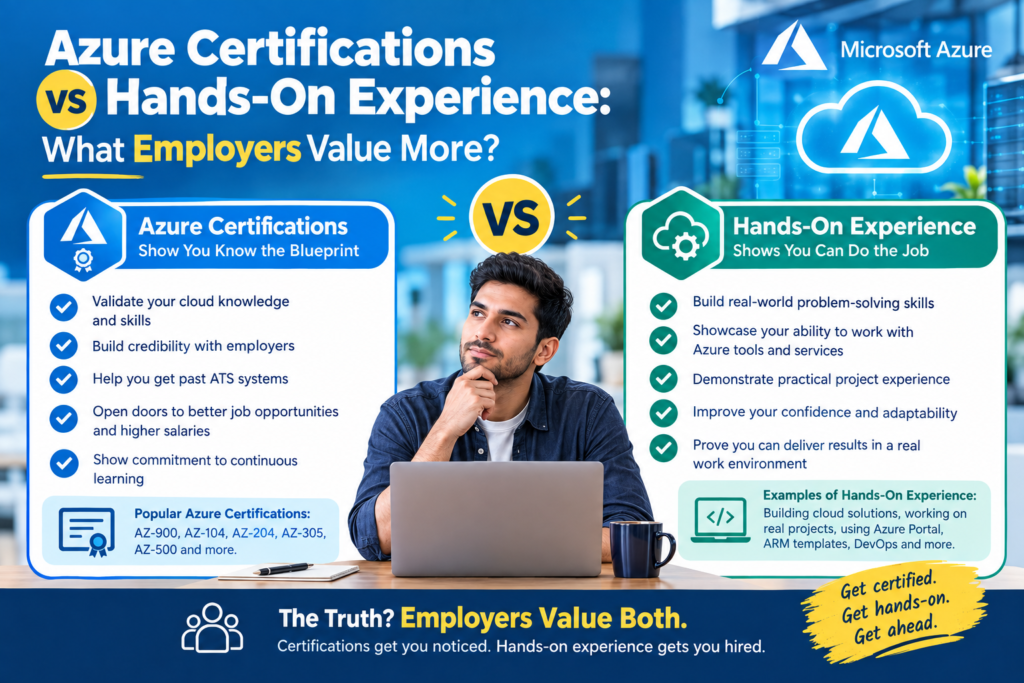
Azure certifications vs hands-on experience is a question that trips up almost every cloud career changer in Australia at some point usually right after they’ve earned their first badge and still don’t feel “employable.” A Microsoft certification proves you understand Azure’s structure and services well enough to pass a proctored exam. Hands-on experience proves you can actually operate, troubleshoot and secure Azure environments under real business constraints. Employers across Sydney, Melbourne, Brisbane, Perth, Adelaide and Canberra consistently say they want both but when forced to choose, the answer isn’t as simple as either side of this debate usually claims.
This guide breaks down exactly what Azure certification proves, what hands-on experience proves, where employer weighting actually falls at each career stage, and how to build both without waiting years for one before starting the other.
What an Azure Certification Actually Proves
Certifications like AZ-900, AZ-104 and AZ-305 verify structured, tested knowledge of Azure services, architecture principles, and best practices in a controlled exam environment. For a recruiter or hiring manager scanning dozens of resumes, a current Azure certification is a fast, low-risk signal: this candidate has at minimum studied Azure’s core concepts in a structured way.
What certification proves well
- Structured knowledge of Azure services, terminology and architecture patterns
- Awareness of Microsoft’s recommended best practices and the Well-Architected Framework
- A consistent, comparable baseline across every candidate who holds it
- Genuine commitment to the Azure ecosystem specifically, rather than cloud in general
What certification does not prove
- Whether you can troubleshoot a live, mid-outage Azure environment under time pressure
- Whether you can navigate cost, governance and security trade-offs unique to a real organisation
- Familiarity with the Azure Portal’s real-world quirks that exam simulations don’t fully replicate
- Collaboration and communication skills needed to work with other IT and business teams
What Hands-On Experience Actually Proves
Genuine hands-on Azure work even from personal labs and structured practice environments demonstrates something a multiple-choice exam can’t: judgment under real constraints. Configuring a resource in a lab is different from configuring it inside an environment with existing naming conventions, cost limits, legacy dependencies and security policies you didn’t create. Hiring managers in Melbourne and Sydney increasingly ask candidates to walk through a project they’ve actually built in Azure during interviews, specifically because it reveals troubleshooting instinct that a certificate number cannot.
What genuine hands-on experience looks like, even without a job title
- A documented personal Azure lab a small resource group, VM, storage account and basic networking, built and explained from scratch
- Evidence you’ve deployed something using Infrastructure as Code (Bicep, ARM templates or Terraform), not just clicked through the Portal
- A troubleshooting story something that broke, how you diagnosed it, and what you changed
- Familiarity with Azure Monitor, cost management, or Entra ID configured in a real (even if small) environment
Head-to-Head: Certification vs Hands-On Experience
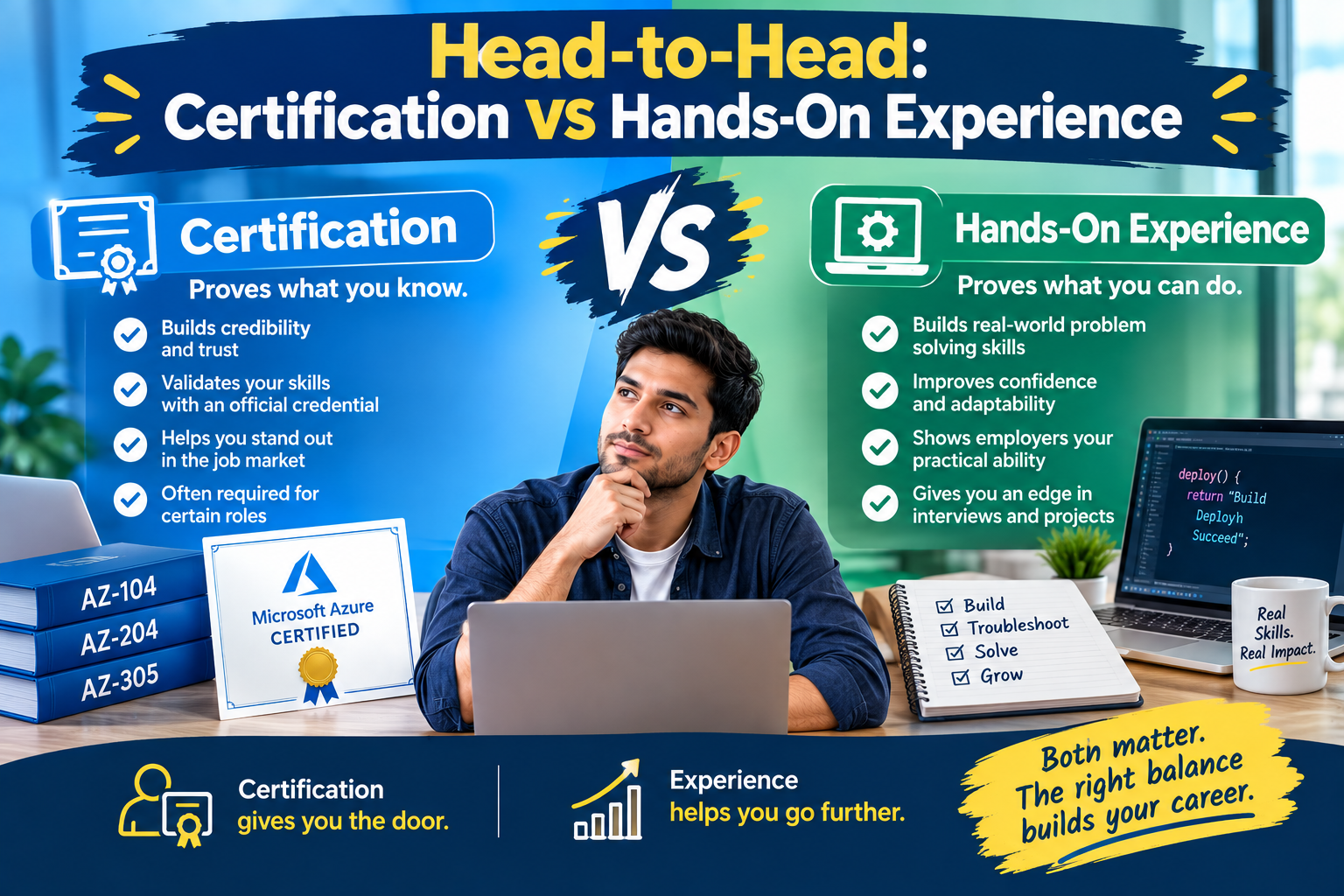
| Factor | Azure Certification | Hands-On Experience |
| Proves structured knowledge | Yes verified by exam | Implied through demonstrated work, not guaranteed |
| Proves applied judgment | Limited | Yes visible in troubleshooting and configuration decisions |
| Fast to verify by employer | Yes badge/certificate number | Slower requires a portfolio review or live walkthrough |
| Weight for entry-level roles | High reduces perceived hiring risk | Valuable, but harder to build without any role yet |
| Weight for mid/senior roles | Expected baseline, rarely decisive alone | Usually the deciding factor in the interview |
| Best used for | Getting shortlisted and passing resume screening | Winning the interview and negotiating seniority |
What Australian Employers Actually Say
Feedback from hiring managers across Brisbane, Perth, Adelaide and Canberra points to a consistent pattern: certification gets a candidate through the initial screening, but hands-on evidence is what decides the outcome once a human is actually reading the resume or running the interview. This is especially true for AZ-104 and AZ-305 level roles, where employers now routinely ask candidates to describe a specific Azure problem they solved, not just list services they’re “familiar with.”
This is exactly the gap the Azure certification courses at azurecertifications.au are built to close pairing exam-aligned content with genuine, lab-based practice, so certification study and hands-on evidence are built together rather than one waiting for the other.
The Smartest Path: Build Both, in Parallel
Rather than treating certification and experience as sequential milestones, the fastest route to being genuinely hireable combines them from day one: study toward a certification, and apply every concept in a real or lab environment as you learn it, rather than saving hands-on practice for “after” the exam.
A practical approach that builds both together
- Set up a free-tier Azure lab environment before you start studying, not after
- As you learn each exam topic, configure it yourself in the lab the same week
- Deliberately break something and document how you fixed it
- Sit the certification once the lab work and exam objectives genuinely overlap, not before
- Keep the lab running and keep adding to it after certification, so it stays a talking point in interviews
Frequently Asked Questions
Is an Azure certification worth it if I already have hands-on experience?
Yes certification formalises and verifies knowledge that hands-on experience alone can’t prove to a recruiter reading a resume for the first time. It’s particularly valuable for passing automated screening and getting shortlisted.
Can I get an Azure job with only certifications and no hands-on practice?
It’s possible for some entry-level roles, but increasingly unlikely for competitive roles, since more Australian employers now ask candidates to walk through real Azure work during interviews rather than relying on certification alone.
Which matters more in an Azure job interview: certification or experience?
Hands-on experience almost always carries more weight in the interview itself, because it demonstrates applied judgment. Certification matters most earlier in the process, for getting shortlisted in the first place.
Final Thoughts
Azure certifications vs hands-on experience isn’t really an either-or decision for candidates hoping to get hired in Sydney, Melbourne, Brisbane, Perth, Adelaide and Canberra it’s a question of building both together. Certification opens the door and proves structured knowledge fast; genuine hands-on experience is what closes the interview and supports a stronger salary negotiation. The candidates who invest in both, in parallel, are consistently the ones who get hired first.
To build both together, Logitrain offers structured, exam-aligned Azure training, and the azurecertifications.au microsite is built specifically around pairing certification study with genuine, lab-based practice.