


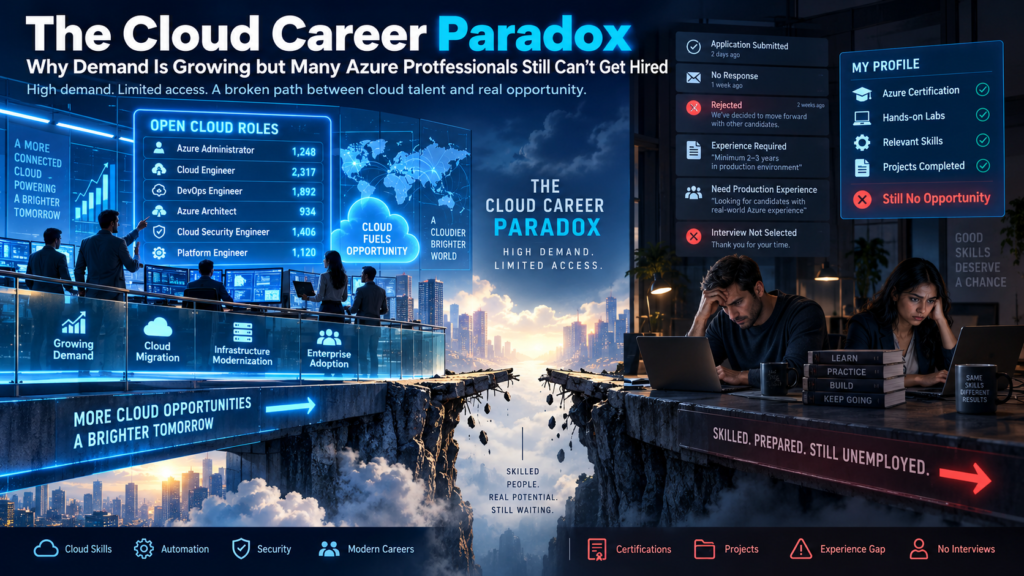
The cloud career paradox is the frustrating reality facing many Azure-certified professionals across Sydney, Melbourne, Brisbane, Perth, Adelaide and Canberra: every industry report says cloud demand is climbing, yet applications go unanswered for months. If you hold an AZ-900, AZ-104 or even AZ-305 and still can’t get an interview, the paradox isn’t about whether Azure skills are in demand they clearly are. It’s about the specific, narrower slice of that demand your resume is actually competing for.
What Is the Cloud Career Paradox?
The cloud career paradox describes the gap between broad, industry-level demand statistics and the much narrower reality of what individual employers are hiring for right now. National reports on cloud skills shortages combine every Azure role from junior administrator to principal cloud architect into one growth figure. But the paradox emerges because most of that growth sits in senior, specialised or migration-project roles, not the entry and mid-level positions most certified candidates are applying for.
Why the Cloud Career Paradox Exists in Australia’s Azure Market
1. Demand Growth Is Concentrated at the Top
Employers in Sydney and Melbourne are expanding headcount fastest for senior architects and specialists who can lead migrations, not entry-level administrators. The cloud career paradox is sharpest here the growth is real, but it rewards depth and specialisation, not a first certification alone.
2. Employers Increasingly Expect Multi-Skill Stacks, Not Just Azure
A candidate with AZ-104 alone now competes against candidates who pair Azure with Infrastructure-as-Code (Bicep or Terraform), security fundamentals, or Azure AI/OpenAI experience. This stacking expectation is a major driver of the paradox the certification opens the door, but the surrounding skill set decides who walks through it.
3. Migration-Driven Hiring Is Project-Based, Not Permanent
A large share of the advertised Azure demand in Brisbane and Perth comes from time-boxed migration projects, often filled through contractors or consultancies with existing talent pools rather than open public applications. This hidden-market effect widens the cloud career paradox for candidates applying only to advertised roles.
4. ATS Filtering Narrows the Field Before a Human Sees It
Larger employers across Adelaide and Canberra run resumes through applicant tracking systems that filter for exact Azure service names and specific certification codes. A resume that says “cloud experience” instead of “AZ-104, Entra ID, Azure Monitor” is often filtered out automatically regardless of the candidate’s real capability.
Closing the Cloud Career Paradox: What Actually Changes Outcomes
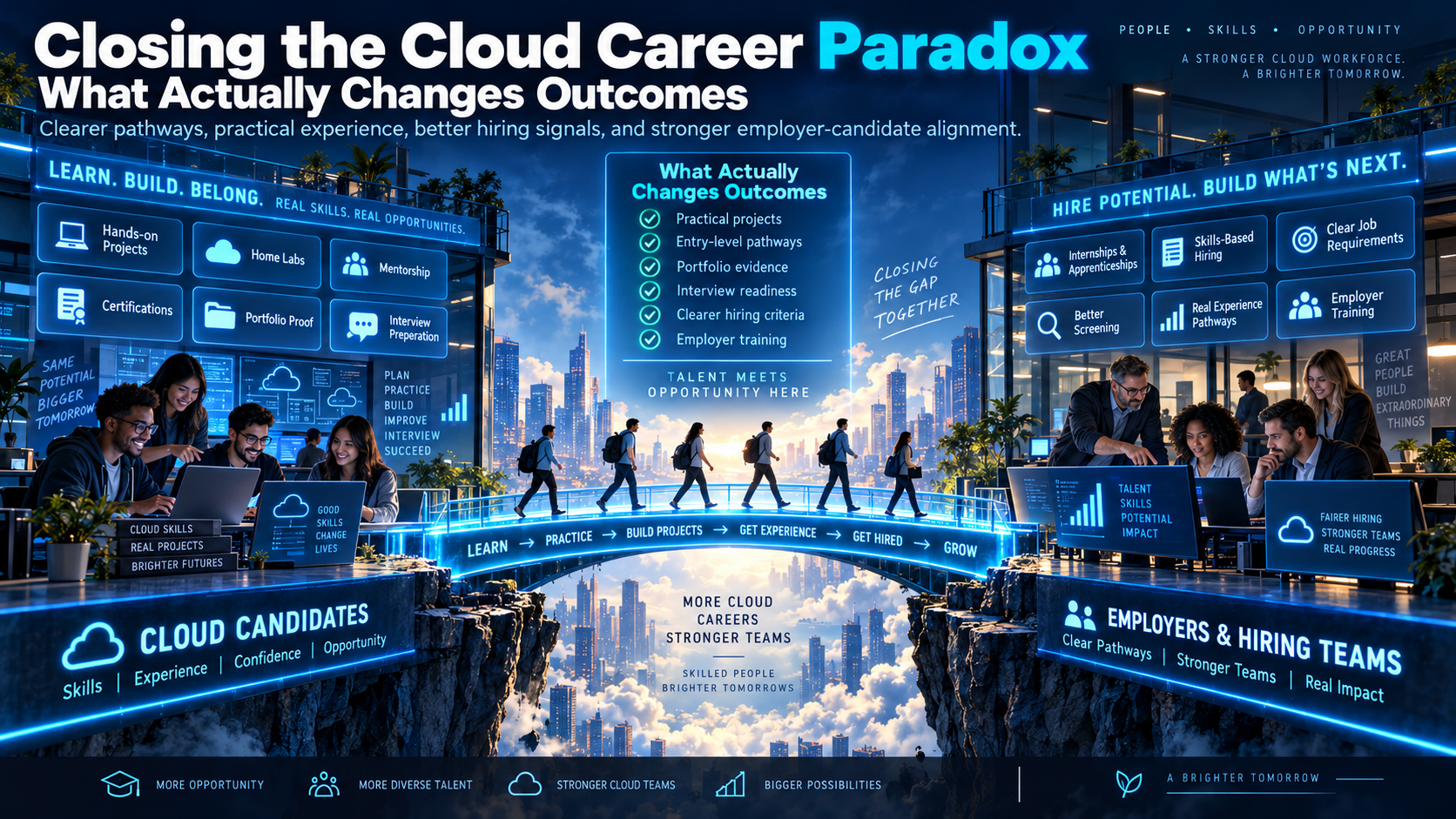
| What Keeps Candidates Inside the Paradox | What Actually Closes the Cloud Career Paradox |
| One certification (e.g. AZ-900) with no hands-on project | A certification pathway plus a documented hands-on Azure project |
| Generic resume phrase: “cloud experience” | Specific service and tool names matching the job ad exactly |
| Applying only to publicly advertised roles | Building relationships with recruiters and consultancies running migration projects |
| Azure skills only, no adjacent stack | Azure paired with IaC, security fundamentals or Azure AI/OpenAI exposure |
| Certification treated as the finish line | Certification treated as the entry point to a demonstrated skill pathway |
City-by-City: Where the Cloud Career Paradox Shows Up Most
The cloud career paradox plays out differently across Australia. In Sydney and Melbourne, the volume of applicants per advertised role means ATS keyword filtering is the biggest hidden barrier. In Brisbane and Perth, much of the real hiring activity happens through migration-project contractors rather than public job boards, leaving direct applicants competing for a smaller visible pool than the headline demand suggests. In Adelaide and Canberra, government and public-sector Azure roles often require security clearance alongside technical certification, narrowing the field further before the paradox is even visible in the numbers.
Certification Pathway That Helps Close the Cloud Career Paradox
- AZ-900 — establishes foundational Azure literacy for career-changers and generalists.
- AZ-104 — the most requested hands-on administrator certification in Australian Azure job ads.
- AZ-305 — signals architecture-level capability for the senior roles where demand is concentrated.
Build a structured, employer-aligned pathway with Azure Certifications, covering AZ-900 through AZ-305 with the hands-on labs that close the paradox between certification and hireability.
For guidance on sequencing your first certifications correctly, see our earlier guide on which Azure certification to take first.
And for the post-certification factors that separate hired candidates from passed-over ones, read why some Azure-certified professionals get hired while others don’t.
All programs are delivered by Logitrain, Australia’s long-established IT training provider, with instructor-led classes across every major city.
What Employment Data Confirms About the Cloud Career Paradox
This pattern is consistent with broader Australian hiring trends Seek’s employer hiring insights repeatedly show that headline demand figures for in-demand tech roles coexist with employers reporting difficulty finding candidates who match specific, current skill requirements.
In other words, the cloud career paradox is not evidence that Azure skills have lost value it confirms that broad demand statistics and specific, current hiring criteria are two different things. Candidates who close that specificity gap consistently move from rejected applications to real interviews.
Closing Thoughts on the Cloud Career Paradox
The cloud career paradox is real, but it is not a sign that Azure careers are a dead end. It reflects a mismatch between broad industry demand and the narrower, more specific skills employers are actually hiring for today. Professionals in Sydney, Melbourne, Brisbane, Perth, Adelaide and Canberra who pair the right certification pathway with hands-on project evidence and a broader adjacent skill stack consistently close this paradox faster than those relying on a single certification alone. The demand is genuine turning it into an offer just takes the right positioning.