


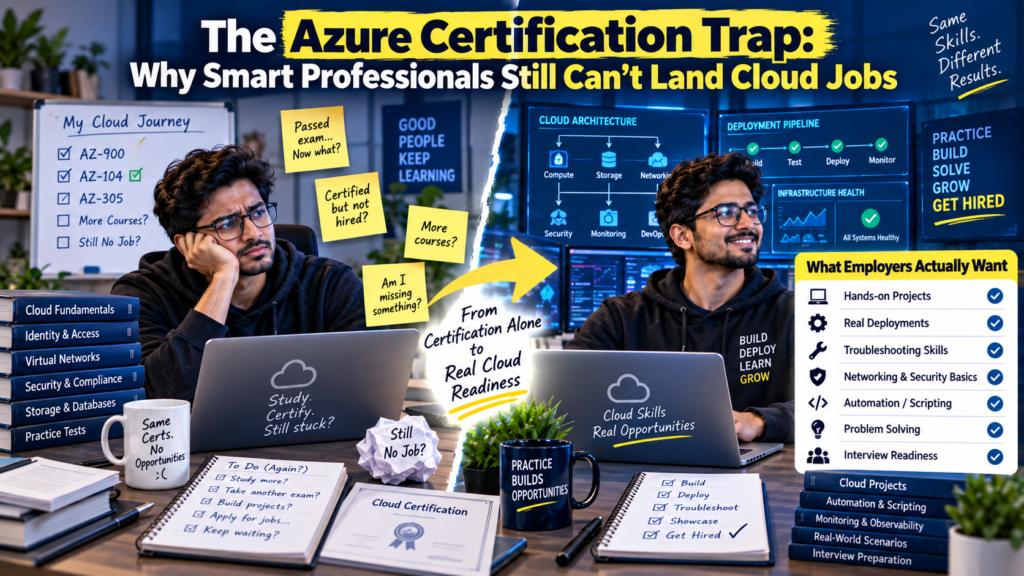
Azure certification jobs don’t arrive with the exam result. That’s the uncomfortable truth behind a pattern that keeps repeating across Australia: a capable IT professional passes AZ-900, then AZ-104, updates their LinkedIn headline, applies for thirty roles, and hears back from two. Same effort, same badge, and a very different outcome from the one the course brochure implied.
This isn’t about intelligence or effort. It’s about how hiring really works. A certificate proves you studied a defined body of knowledge and passed a test. An employer hiring for a cloud role is asking something else entirely: can I trust this person with a live environment, a budget and a deadline? Those two questions get confused, and the gap between them is what we call the certification trap.
In this guide you’ll see why certified professionals get overlooked, what employers are really screening for, which certification suits which role, and a practical plan for landing Azure certification jobs in 90 days. If you’d like the big picture first, our Azure certification roadmap for Australia lays out every level.
What Is the Azure Certification Trap?
The trap is treating the exam as the finish line. You study for weeks, pass, feel the relief, and assume the market will respond. But an exam is a controlled test with a fixed syllabus. A cloud job is the opposite: half-documented systems, vague requirements, and someone senior asking why the monthly bill doubled.
Here’s a scenario that plays out constantly. Picture a helpdesk analyst, call her Priya, who earns AZ-104 after months of evening study. Her CV now lists the certification at the top and the same helpdesk duties underneath. A recruiter sees the badge and shortlists her. Then the hiring manager asks one question: “What have you actually built in Azure?” Priya has answers about exam domains, not about a system she designed, broke and fixed. The interview stalls.
Demand isn’t the problem. The Australian Computer Society’s Digital Pulse 2025 analysis suggests closing digital skill gaps could be worth around $25 billion to the economy by 2035, as reported by Information Age. But demand for skills isn’t the same as demand for certificates. Employers are short of people who can do the work, and that’s where Azure certification jobs are won or lost.
Why Azure Certification Jobs Stay Out of Reach: 5 Common Reasons
1. You have a badge but no story
Behavioural interviews are built around “tell me about a time”. If your best answer starts with “when I was studying for the exam”, the room cools quickly. Candidates who win Azure certification jobs usually have a concrete story: a problem, a decision, a result. It doesn’t have to come from a paid job. A well-documented home lab counts, as long as you can explain the choices you made.
2. Your CV lists services instead of outcomes
On a CV aimed at Azure certification jobs, “Familiar with Virtual Machines, Storage Accounts and Microsoft Entra ID” tells a reader nothing they couldn’t guess from the certification title. Compare it with: “Built a two-tier web app in Azure with a virtual network, network security rules and automated backups, then documented the design with a monthly cost estimate.” The second line proves competence, shows you think about cost, and hands the interviewer something to ask about.
3. You picked the wrong certification for the role
A surprising number of applications fail because the credential doesn’t match the job. AZ-900 alone rarely satisfies an engineer-level advertisement, and many Azure certification jobs at that level expect an associate credential plus evidence you’ve used it. Choosing your certification backwards from the role you want is the cheapest fix on this list. The table further down shows the mapping, and our Azure certification comparison for Australia goes deeper.
4. Nothing proves you’ve touched a real environment
Employers can’t see inside your head, so they look for artefacts: a GitHub repository, an architecture diagram, a short write-up. You don’t need company access to create them. Microsoft’s Azure free account lets you build and experiment at no upfront cost, provided you stay within the free limits and keep an eye on usage. Build something small, delete what you don’t need, and keep the documentation.
5. You skipped the unglamorous skills employers actually pay for
Exams reward service knowledge. Hiring managers reward judgement: governance, identity, monitoring, cost control and security. Microsoft’s Azure Well-Architected Framework organises that thinking into five pillars: reliability, security, cost optimisation, operational excellence and performance efficiency. If you can talk through the trade-offs between them for a system you built, you’ll sound more senior than someone who can list fifty services.
What Employers Actually Want From Azure Certification Jobs Candidates
Most Azure certification jobs are advertised in shorthand. Behind each phrase sits a real worry the hiring manager is trying to settle. Reading between the lines is half the battle.
| What the job ad says | What the hiring manager is really asking | How you can show it |
| “Hands-on Azure experience” | Have you operated something real, not just read about it? | A documented project in your own subscription |
| “Security awareness” | Will you leave a storage account open to the internet? | Least-privilege access, network rules and Azure Policy in your project |
| “Automation / infrastructure as code” | Can you repeat this without clicking through the portal? | Bicep, Terraform or PowerShell in a public repository |
| “Cost awareness” | Will your resources blow the budget? | Tags, budgets, alerts and right-sizing notes |
| “Strong communication” | Can you explain a trade-off to a non-technical manager? | A one-page design note that states cost and risk plainly |
| “Troubleshooting skills” | What do you do when it breaks at 2 am? | A short write-up of a failure you caused and fixed |
None of this makes certification worthless. Recruiters and partner organisations still use it as a filter, and it shows you can commit to structured learning. The winning combination is certification plus proof: the certificate gets you into the conversation, and the proof keeps you there. For a wider view of what’s in demand, read our guide to the top Azure skills employers want in Australia in 2027, or our breakdown of Azure certifications vs hands-on experience.
Which Azure Certification Fits Your Target Role?
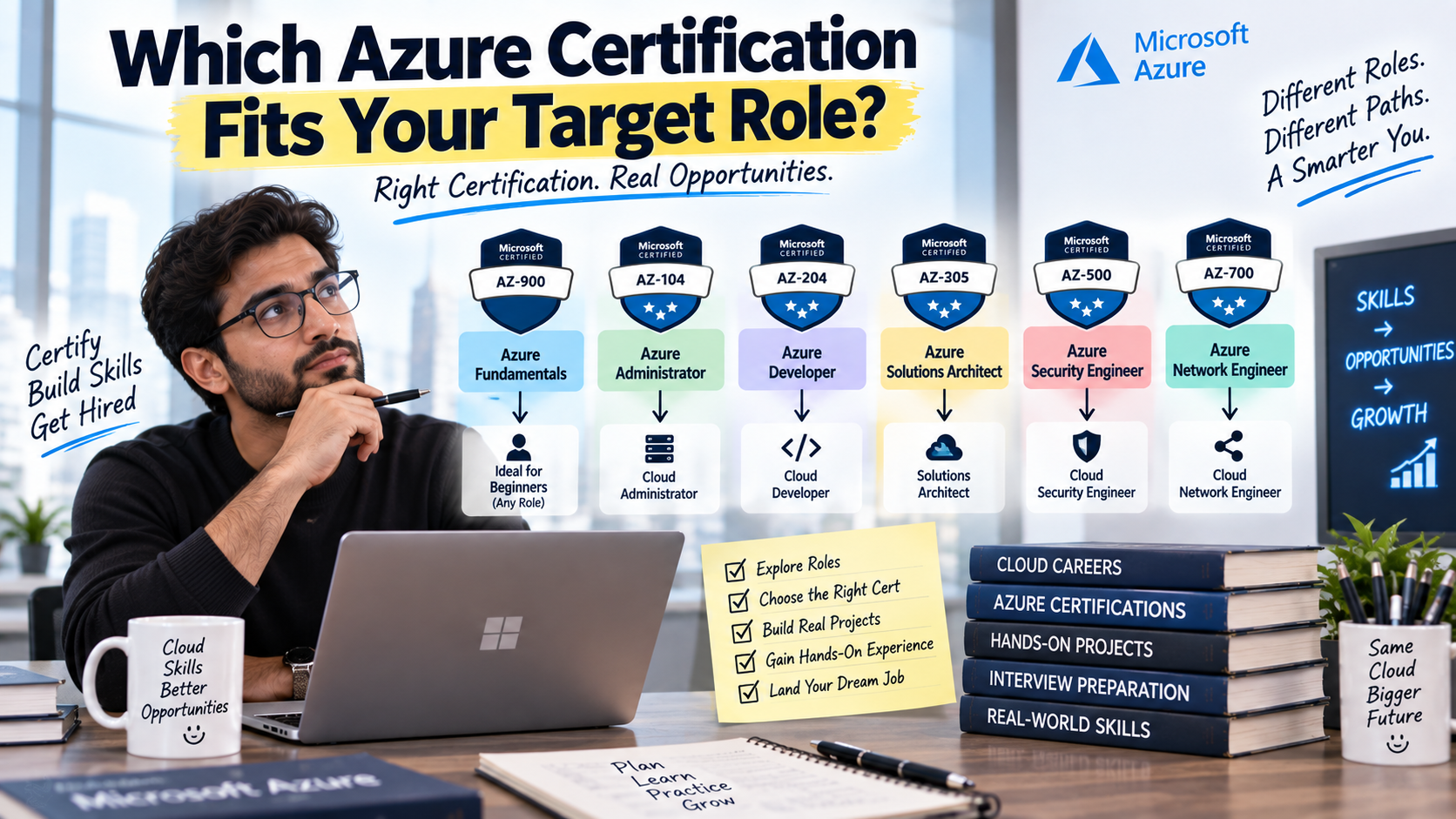
Start with the role, then choose the exam. This map covers the certifications most closely tied to Azure certification jobs in Australia, with a link to each course.
| If you want to be a… | Start with this certification | Who it suits |
| Cloud beginner or career changer | AZ-900 Azure Fundamentals | Students, sales, project and support staff, and anyone new to cloud |
| Cloud or systems administrator | AZ-104 Azure Administrator | Sysadmins and support engineers managing Azure infrastructure |
| Azure developer | AZ-204 Developing Solutions for Azure | Developers building and deploying cloud applications |
| Network engineer | AZ-700 Azure Networking Solutions | Network professionals designing hybrid and cloud connectivity |
| Security engineer | AZ-500 Azure Security Technologies | Security and SecOps staff protecting identities, data and networks |
| Solutions architect | AZ-305 Azure Solutions Architect | Experienced engineers designing enterprise Azure solutions |
| DevOps engineer | AZ-400 Microsoft DevOps Solutions | Engineers automating delivery pipelines and operations |
Experienced IT professionals can often skip fundamentals and go straight to an associate certification. Career changers usually benefit from starting with AZ-900 to learn the vocabulary. Expert-level paths such as AZ-305 typically build on associate-level experience, so give yourself time in a real or lab environment first. Browse the full list on our Azure certifications page.
A 90-Day Plan for Landing Azure Certification Jobs
You don’t need another degree. You need one small, finished, well-explained project and a CV that shows it. Here’s a realistic plan you can follow alongside your studies.
- Days 1 to 14: choose one target role. Collect ten job ads for it and note the skills that appear in at least half of them. That list, not the exam blueprint, becomes your study filter.
- Days 15 to 45: build one project end to end. A virtual network, a virtual machine or App Service, backups, monitoring alerts and a budget alert is plenty. Small and complete beats big and abandoned.
- Days 46 to 60: automate and document it. Rebuild the project with Bicep, Terraform or PowerShell, store it in a public repository, and add a README with an architecture diagram and a rough monthly cost.
- Days 61 to 75: rewrite your CV and LinkedIn profile. Lead with what you built, list the certification underneath, and mirror the language of your target ads honestly.
- Days 76 to 90: practise and apply. Explain your project aloud in five minutes, name two design trade-offs, and describe one thing that went wrong and how you fixed it. Then apply, including to managed service providers, Microsoft partners and internal cloud teams.
Where to Train for Azure Certification Jobs in Australia
Cloud hiring is concentrated in the capital cities, so most Azure certification jobs sit there too, but you don’t need to relocate to train. Courses run in classrooms and live online, and each city page shows local options.
- Melbourne: instructor-led classes at our West Melbourne centre, plus live online sessions.
- Sydney: classroom training in Surry Hills, close to many enterprise and financial-services employers.
- Brisbane: classroom training in the Brisbane CBD for professionals across the city and surrounding suburbs.
- Perth: classroom and live online options for Western Australian professionals and teams.
- Adelaide: live online or in-house delivery for South Australian learners and teams.
- Canberra: live online or in-house delivery, well suited to teams working with security and compliance needs in government settings.
Not sure which page applies? See all Azure certification locations or contact our team and we’ll help you choose.
Keep Your Azure Certification Credible
Recruiters screening for Azure certification jobs notice when a badge has quietly expired. Microsoft’s associate, expert and specialty certifications are valid for one year, and they can be renewed for free through an online assessment on Microsoft Learn. Fundamentals certifications, including AZ-900, don’t expire. The renewal window opens six months before expiry, so set a calendar reminder rather than relying on an email. Full details are on Microsoft’s certification renewal page.
Treat renewal as a cheap prompt to refresh your skills. It keeps your CV, your project and your interview answers current.
Azure Certification Jobs: Frequently Asked Questions
Can I get Azure certification jobs with only AZ-900?
Rarely for technical roles on its own. AZ-900 proves foundational cloud literacy, which is useful for sales, project and support roles and as a first step. Technical hiring managers usually want an associate-level certification plus hands-on evidence.
Is an Azure certification worth it in Australia?
Yes, when it’s paired with proof of real work. It helps you pass recruiter filters and gives your learning structure. Azure certification jobs tend to go to candidates who can show both the credential and something they built.
How long does it take to land Azure certification jobs after passing?
There’s no honest universal number. Candidates who build and document a project while they study tend to move faster than those who start after the exam. Use the 90-day plan above as a working timeline, not a promise.
Which Azure certification should I take first?
If you’re new to cloud, start with AZ-900. If you already work in IT, pick the associate certification that matches your target role, such as AZ-104 for administration or AZ-204 for development.
Do I need IT experience before an Azure course?
Not for fundamentals. Associate and expert courses suit people with some background in IT, networking, development or security. More answers are in our Azure certification FAQs.
Escape the Azure Certification Trap
The people who land Azure certification jobs aren’t necessarily the smartest in the room. They pair a relevant certification with visible, well-explained work. Choose the certification that fits your target role, build something real, and write it up in plain language.
If you’d like structured help preparing for Azure certification jobs, explore our Azure certification courses, call 1300 649 299, or send us an enquiry.