


Career adaptability is quickly becoming the quality that separates people who keep getting opportunities from people who keep getting overlooked. For decades the safe advice was simple: put in the years, build a long CV and let experience do the talking. That advice is ageing badly. Technology, artificial intelligence and cloud platforms now rewrite job descriptions faster than most of us update a LinkedIn headline, and a résumé full of seniority no longer guarantees you can handle whatever lands on your desk next quarter.
None of this means experience is worthless. It means experience has shifted from a trophy to a starting point. In this guide you’ll see why adaptability is replacing experience as the most valuable career asset, what employers in Sydney, Melbourne and Brisbane are really screening for, and how to build career adaptability in a practical, repeatable way, including through structured learning such as Microsoft Azure certification.
What Is Career Adaptability and Why Does It Matter Now?
Career adaptability is your ability to learn quickly, adjust to change and keep performing when the rules of your job shift. Researchers in vocational psychology, most notably Mark Savickas through his career construction theory, describe it as a set of attitudes, beliefs and competencies that help people cope with work transitions, both the predictable ones and the nasty surprises. It is less about what you already know and more about how you respond when what you know stops being enough.
That distinction matters because modern careers rarely run in a straight line. People change employers, industries and sometimes whole professions several times. Restructures, automation and new tools turn up with very little warning. In that environment, the person who can reskill in six weeks is worth more than the person who spent ten years mastering a system that’s about to be retired.
Why Experience Alone Is Losing Its Value
Experience used to work as a reliable shortcut. If someone had fifteen years in finance, logistics or IT support, you could assume they’d seen most problems. The shortcut breaks down when the problems themselves keep changing.
Think of experience as a bank balance that earns less interest every year unless you keep topping it up. A decade of hands-on work with on-premises servers is genuinely useful, but it doesn’t automatically translate into running workloads in the cloud. Employers know this. Many have stopped asking “how long have you done this?” and started asking “what have you learned lately, and how fast did you pick it up?”
Three forces explain why experience depreciates:
- A shorter skill shelf life. Tools, platforms and regulations turn over faster than they used to, so yesterday’s expertise can expire quietly.
- Hidden habits. Long tenure can lock in routines that resist new ways of working, even when the person is talented.
- Skills-based hiring. More employers now screen for demonstrable, current skills and recognised credentials rather than years served.
If this sounds uncomfortably familiar, our piece on the relevance gap explains how professionals slip out of demand without noticing, and legacy IT skills covers the same trap in technical roles.
What the Data Says About Skills and Change
The World Economic Forum’s Future of Jobs Report 2025 estimates that roughly 39 per cent of the core skills workers rely on are expected to change by 2030. It also projects that about 170 million new roles will be created over the same period while around 92 million are displaced. Resilience, flexibility and agility sit among the fastest-growing skills on its list.
Australia tells a similar story. Jobs and Skills Australia regularly publishes workforce analysis that points to persistent demand for digital and technology capability, and the Australian Bureau of Statistics labour data shows how often workers move between roles and industries. Put those signals together and the message is hard to ignore: employers are short of people with current skills, and the definition of “current” keeps moving.
The Four Building Blocks of Career Adaptability
Savickas framed career adaptability around four resources, often called the four Cs. They make a handy self-assessment checklist.
- Concern: looking ahead and paying attention to where your industry is going instead of waiting to be told.
- Control: taking ownership of your direction, making decisions and following through rather than drifting.
- Curiosity: exploring new roles, tools and ideas before you’re forced to.
- Confidence: believing you can learn what’s needed and act on it.
Notice that none of these depend on a particular job title or number of years in the workforce. You can start building each one this week, which is exactly why career adaptability levels the playing field for graduates, career changers and mid-career professionals alike.
Experience vs Career Adaptability: How Employers Compare Them
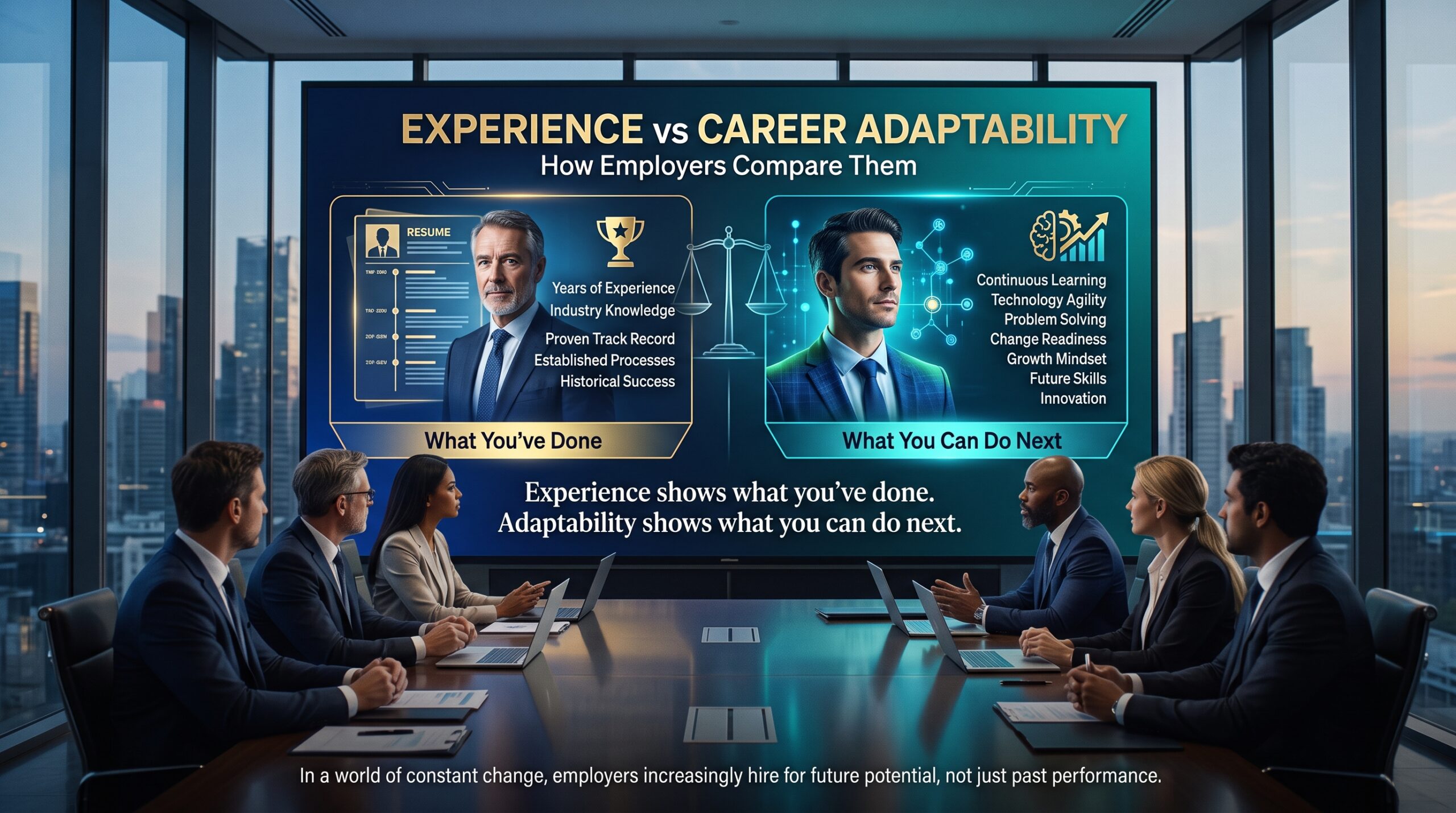
| Factor | Experience | Career Adaptability |
| Hiring signal | Years in role, past job titles | Recent learning, certifications, projects |
| Value over time | Depreciates unless refreshed | Compounds with every new challenge |
| Response to change | Falls back on proven methods | Tests new approaches quickly |
| Risk for employer | May resist new systems | Faster onboarding to new tools |
| Best use | Deep judgement in stable fields | Fast-moving fields like cloud, AI and cybersecurity |
The smartest candidates combine both. Experience supplies judgement. Adaptability keeps that judgement relevant.
How to Build Career Adaptability: A Practical 6-Step Plan
- Audit your skills honestly. List what you do each week and mark the tasks that could be automated, outsourced or changed within three years.
- Pick one growth skill. Choose a skill tied to real demand in your field rather than whatever happens to be trending on social media.
- Learn in 30-day sprints. Commit to short cycles with a visible outcome, such as a lab, a small project or a practice exam.
- Earn a credential that proves it. Certifications give employers a quick, trusted signal that your skills are current.
- Seek unfamiliar work. Volunteer for cross-team projects, pilots and tasks outside your comfort zone.
- Build a feedback habit. Ask managers and peers what you should start, stop and keep doing, then act on one thing each quarter.
This is the opposite of what we call the comfort zone tax. Standing still feels safe, but it quietly costs you promotions, pay rises and options.
Career Adaptability in Tech: Why Cloud Skills Lead the Way
Technology is where career adaptability gets tested hardest. Cloud platforms such as Microsoft Azure release new services and features constantly, so the people who work with them learn how to learn as part of the job. That’s why cloud certifications make a practical vehicle for building adaptability: they demand structured study, hands-on practice and an exam that confirms you can apply what you’ve learned.
Here is how the main Azure pathways map to different career moves:
- AZ-900 Azure Fundamentals: cloud literacy for beginners, career changers and non-technical staff.
- AZ-104 Azure Administrator: for IT professionals managing identity, networking, storage and compute.
- AZ-204 Azure Developer: for developers building and deploying cloud-native applications.
- AZ-700 Azure Networking Solutions: for network engineers designing and securing Azure connectivity.
- AZ-500 Azure Security Technologies: for security engineers protecting identities, data and workloads.
- AZ-305 Azure Solutions Architect: for experienced professionals designing scalable cloud solutions.
- AZ-400 DevOps Solutions: for engineers connecting development, operations and automation.
Not sure where to begin? Walk through the Azure certification roadmap for Australia or use the Azure certification comparison guide to match a pathway to your background. Microsoft also lists every role-based credential in its official catalogue on Microsoft Learn. And if postponing the decision feels harmless, read why delaying cloud learning gets more expensive every year.
Where to Build Career Adaptability in Australia
Demand for flexible, cloud-ready professionals runs across the country’s major cities, and training is available in person at selected centres or live online:
- Azure certification training in Melbourne
- Azure certification training in Sydney
- Azure certification training in Brisbane
- Azure certification training in Perth
- Azure certification training in Adelaide
- Azure certification training in Canberra
You can also see every option on the Azure certification locations page, or read about the team on the About Us page.
There is a bigger picture here too. If you’ve ever wondered why certified professionals in Sydney, Melbourne or Perth still struggle to land interviews, the cloud career paradox explains how skills, positioning and timing interact, while the cloud skills gap article shows what employers say they can’t find.
Common Mistakes That Hold Back Career Adaptability
- Waiting for permission. Employers rarely hand out learning time. The adaptable people carve it out themselves.
- Collecting courses without applying them. Knowledge only sticks when you use it on a real task or lab.
- Confusing busy with learning. A packed calendar isn’t growth. Track what you can do now that you couldn’t do three months ago.
- Treating one certification as the finish line. The credential is the proof; the habit of learning is the asset.
- Neglecting people skills. Communication, collaboration and problem solving travel with you into every new role.
Career Adaptability FAQs
What is career adaptability?
Career adaptability is the capacity to prepare for, respond to and recover from changes at work. It combines curiosity, planning, confidence and a willingness to keep learning as roles and technologies evolve.
Is adaptability more important than experience?
For most fast-moving fields, yes, or at least equally important. Experience shows what you’ve done. Adaptability shows what you can do next. Employers increasingly weigh recent learning and proven skills alongside, and sometimes ahead of, years in the role.
Can you develop career adaptability at any age?
Absolutely. Adaptability is a set of habits, not a personality type. Setting a regular learning rhythm, taking on unfamiliar tasks and earning current credentials will strengthen it whether you’re 22 or 52.
How do you show career adaptability on a resume?
Highlight times you learned a new tool quickly, changed roles or industries, led a process change or earned a recent certification. Specific outcomes such as “migrated 40 servers to Azure within a quarter” beat vague claims about being a fast learner.
Which certification should I start with to future-proof my career?
If you’re new to cloud, AZ-900 Azure Fundamentals is the usual starting point. It builds core knowledge before you move to role-based paths such as AZ-104 or AZ-500. You can also check the FAQs page for more detail.
Final Thoughts: Make Career Adaptability Your Competitive Edge
Experience will always matter, but it no longer carries a career on its own. The professionals who stay in demand are the ones who treat learning as part of the job, test new skills early and prove them with recognised credentials. Start small: pick one skill, set a 30-day sprint and book the exam that locks it in.
Ready to take the next step? Browse the Azure certification courses, explore the latest articles on the blog, or contact the team on 1300 649 299 to talk through the right pathway for your goals.