

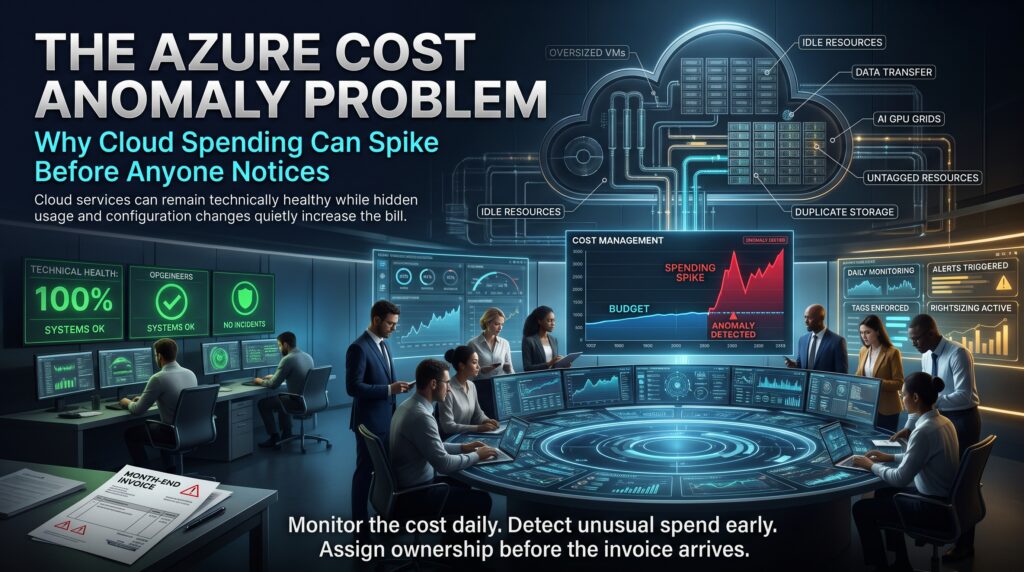


Azure governance is the set of rules, structures and habits that keep a cloud environment secure, affordable and understandable as it grows. When it is missing or has fallen behind, you get what this article calls the Azure governance gap: the widening distance between how fast your teams build in Azure and how well anyone can still see, control and explain what has been built.
The strange part is that this gap rarely appears in failing projects. It appears in successful ones. A company moves its first workloads to Azure, the migration goes well, other teams notice, and within two years there are dozens of subscriptions, hundreds of resource groups and a bill nobody can fully explain. Success created demand, demand created speed, and speed outran the rules.
If you manage a cloud platform, work in a cloud team, or you are planning an Azure career, this guide walks through why the gap opens, how to spot it, and what a practical fix looks like. It also covers the certifications that build these skills and how the problem plays out in Australian cities.
What Is the Azure Governance Gap?
The Azure governance gap is the difference between the environment you designed and the environment you now operate. On paper you might have a clean subscription layout, a tagging standard and a naming convention. In practice you have exceptions, one-off projects, orphaned resources, broad permissions granted in a hurry and policies that exist but are not enforced.
Governance in Azure usually covers six areas:
- Structure: management groups, subscriptions and resource groups that mirror how the business actually works.
- Standards: Azure Policy rules that define what can and cannot be deployed.
- Access: Azure role-based access control (RBAC), Microsoft Entra ID and Privileged Identity Management.
- Cost: budgets, tagging, ownership and regular cost reviews.
- Security and compliance: Microsoft Defender for Cloud, regulatory baselines and audit evidence.
- Operations: monitoring, resource lifecycle and repeatable deployment through infrastructure as code.
A healthy model covers all six. A gap usually means one or two are strong and the rest were never finished.
Why Successful Cloud Environments Become Hard to Manage
Cloud environments rarely become messy because someone was careless. They become messy because growth changes the problem faster than the operating model can adapt. Most organisations pass through the same stages:
| Stage | What is happening | Governance symptom |
| Pilot | One team, one subscription, a handful of services | Everything is manageable by memory, so no standards are written |
| Early adoption | More workloads and more teams join | Naming, tagging and access are decided team by team |
| Rapid growth | Dozens of subscriptions, multiple regions, several vendors | Policies are inconsistent and owners are unclear |
| Scale | Hundreds of resources per team, shared services, compliance pressure | Costs, risks and dependencies are hard to trace |
| Control crisis | An audit, a bill shock or a security incident forces attention | Governance is bolted on retroactively, which is slow and disruptive |
The pattern is predictable. The first workload needs very little governance, so very little is built. By the time the need is obvious, the environment is large enough that every fix touches live systems. That is why the Azure governance gap feels sudden even though it built up quietly over months.
Three forces make it worse. First, Azure makes it easy to deploy, and that is a feature, not a flaw. Second, teams are rewarded for delivery, not for tidiness. Third, the people who set up the first environment often move on, taking the reasoning behind early decisions with them.
Warning Signs of an Azure Governance Gap
You do not need a formal assessment to see the early signals. These are the ones cloud teams mention most often:
- Nobody can say with confidence who owns a given subscription or resource group.
- The monthly Azure bill has line items that no one can explain.
- Resources appear in the wrong regions or use unapproved SKUs.
- Permissions have accumulated over time and several people hold Owner access “just in case”.
- Tags are inconsistent, so cost reports cannot be split by team or project.
- Azure Policy exists in audit mode only, so non-compliant resources are reported but never prevented.
- Defender for Cloud shows a long list of recommendations that nobody is assigned to fix.
- Deployments are done through the portal rather than templates, so environments drift apart.
If more than three of these sound familiar, the gap is probably already affecting cost, security or delivery speed, whether or not anyone has named it.
The Real Cost of Poor Azure Governance
The impact usually shows up in three places. The first is money. Idle virtual machines, oversized databases, unattached disks and forgotten test environments keep billing quietly. Practitioners in the FinOps community consistently point to unmanaged spend and unclear ownership as the root of most cloud waste, not unusual pricing.
The second is security. Overly broad roles, public endpoints, missing diagnostic logs and inconsistent network rules widen the attack surface. For Australian organisations aligning to the ACSC Essential Eight or frameworks such as ISO 27001, weak governance makes it much harder to produce the evidence an auditor asks for. If this area interests you, our related guides at Cyber Security Certifications go deeper on the security side.
The third is speed. Ironically, a lack of governance slows teams down. Engineers spend time working out what exists, requesting access, untangling dependencies and waiting for ad hoc approvals. Good governance removes friction by deciding the rules once, in code, instead of renegotiating them for every project.
How to Close the Azure Governance Gap: A Practical Framework
Microsoft’s Cloud Adoption Framework governance guidance offers a structured approach, and the Azure landing zone pattern gives a reference architecture. Here is how those ideas translate into a workable plan.

1. Fix the structure first
Use management groups to organise subscriptions by environment, business unit or risk level, and apply policy and access at the highest sensible level so it flows downward. A clear hierarchy is the foundation for every other control. Without it, each fix has to be repeated many times.
2. Turn standards into Azure Policy
A written standard that nobody enforces is a suggestion. Azure Policy lets you require tags, restrict regions, block unapproved SKUs and enforce encryption or diagnostic settings automatically. Start in audit mode to see the impact, then move the important rules to deny or deploy-if-not-exists. Done well, governance becomes automatic instead of dependent on reminders.
3. Tighten identity and access
Review who holds Owner and Contributor access, move to least privilege, and use Privileged Identity Management for just-in-time elevation. Assign roles to groups rather than individuals, and review them on a schedule. Access sprawl is one of the fastest-growing parts of any governance gap.
4. Make cost visible and owned
Enforce a small, mandatory tag set such as owner, cost centre and environment. Set budgets and alerts in Azure Cost Management, and give every subscription a named owner who sees their own spend. Cost conversations improve dramatically once costs have names attached.
5. Connect security posture to action
Defender for Cloud’s secure score and recommendations are only useful if they are triaged. Assign recommendations to owners, track them like any other backlog, and map your policies to the regulatory baselines you care about. This turns the gap from a vague worry into a list of tickets with deadlines.
6. Standardise deployment with infrastructure as code
Bicep or Terraform templates, stored in source control and deployed through pipelines, remove drift and make every environment reproducible. When the portal is the exception rather than the rule, governance gets much easier because the code is the record of what should exist.
7. Review on a rhythm
Governance is not a project with an end date. Schedule monthly cost reviews, quarterly access reviews and regular policy health checks. A short, boring, repeating review beats an exhausting annual clean-up.
A 90-Day Plan to Reduce Your Azure Governance Gap
| Timeframe | Focus | Outcome to aim for |
| Days 1 to 30 | Discover and document | Full list of subscriptions, owners, costs and public endpoints; tag standard agreed |
| Days 31 to 60 | Structure and guardrails | Management group hierarchy in place; priority Azure Policy rules running in audit mode |
| Days 61 to 90 | Enforce and automate | Key policies moved to deny; access reviews scheduled; budgets and alerts live; IaC for new workloads |
Ninety days will not fix everything, but it is enough to stop the gap growing and to give leadership clear evidence of progress.
Azure Governance Tools and Services at a Glance
| Governance need | Azure service | What it does |
| Hierarchy and scope | Management groups, subscriptions | Organises resources and inherits policy and access |
| Standards enforcement | Azure Policy | Audits or enforces rules on resources |
| Access control | Azure RBAC, Microsoft Entra ID, PIM | Controls who can do what, and for how long |
| Cost control | Azure Cost Management, budgets, tags | Tracks, allocates and alerts on spend |
| Security posture | Microsoft Defender for Cloud | Assesses configuration and compliance |
| Inventory and queries | Azure Resource Graph | Searches resources across subscriptions at scale |
| Observability | Azure Monitor, Log Analytics | Collects metrics and logs for operations and audit |
| Repeatable deployment | Bicep, Terraform, Azure DevOps, GitHub Actions | Deploys consistent infrastructure from code |
Azure Certifications That Build Governance Skills
Governance is a skill employers actively look for, and Microsoft certifications give you a structured way to prove it. These are the most relevant paths:
| Certification | Governance focus | Who it suits |
| AZ-900 Azure Fundamentals | Core concepts including governance, compliance and cost management tools | Beginners and non-technical roles |
| AZ-104 Azure Administrator | Subscriptions, RBAC, Azure Policy, cost and resource management | Cloud administrators and support engineers |
| AZ-305 Azure Solutions Architect | Designing governance, identity and management strategies | Architects and senior engineers |
| AZ-500 Azure Security Engineer | Security governance, identity protection and Defender for Cloud | Security and cloud security engineers |
| AZ-400 DevOps Engineer | Infrastructure as code, pipelines and policy as code | DevOps and platform engineers |
If you are not sure where to begin, start with the pathway guides on azurecertifications.au and book a live online class through Logitrain. Many learners begin with AZ-900, move to AZ-104 for hands-on administration and then branch into AZ-305, AZ-500 or AZ-400 depending on the role they want.
How the Azure Governance Gap Shows Up Across Australian Cities
| City | Typical Azure environment | Common governance challenge |
| Sydney | Financial services, fintech and large enterprise with multi-subscription estates | Regulatory evidence, cost allocation across business units |
| Melbourne | Healthcare, education, telecommunications and consulting | Data sensitivity and consistent access control across many teams |
| Brisbane | Growing mid-size companies, logistics and resources | Fast growth with no agreed tagging, naming or ownership standard |
| Perth | Mining, energy and engineering with hybrid and remote-site workloads | Hybrid connectivity, cost control and governance for edge workloads |
| Adelaide | Defence supply chain, manufacturing and health | Supplier access, compliance and tighter security baselines |
| Canberra | Federal agencies and government contractors | Strict policy, data residency and audit requirements |
Whatever the city, the pattern repeats: organisations that treat Azure governance as an early design decision spend less time and money fixing it later. Professionals who can show they understand policy, access and cost control are in demand in Sydney, Melbourne, Brisbane, Perth, Adelaide and Canberra, and increasingly through remote and hybrid roles.
Frequently Asked Questions About Azure Governance
What is Azure governance?
Azure governance is the combination of structure, policy, access control, cost management and monitoring that keeps an Azure environment secure, compliant and manageable as it scales.
What causes an Azure governance gap?
It usually comes from fast growth without matching investment in standards. Teams deploy quickly, exceptions pile up and the original design no longer matches reality.
Which Azure service is central to governance?
Azure Policy is the main enforcement tool, working alongside management groups for hierarchy, RBAC for access and Cost Management for spend. No single service does it all, which is why the overall design matters.
Is Azure governance only for large enterprises?
No. Smaller organisations benefit from simple guardrails early, such as a tag standard, a sensible subscription layout and least-privilege access. It is far cheaper to start small than to retrofit later.
Which certification should I take to learn Azure governance?
AZ-104 is the strongest practical starting point for governance topics, with AZ-305 for design-level thinking and AZ-500 for security governance. AZ-900 is a good first step if you are new to the cloud.
Final Thoughts: Governance Is What Lets Cloud Success Last
Strong Azure governance does not slow a business down. It is what allows a successful environment to keep growing without becoming a liability. The organisations that handle the Azure governance gap best are not the ones with the most tools. They are the ones that agreed on a few clear rules early, automated them and kept reviewing them.
If you want to build these skills professionally, explore the certification pathways at azurecertifications.au, compare AZ-104, AZ-305, AZ-500 and AZ-400, and enrol in a live online class with Logitrain. Start with one subscription, one policy and one owner, then build from there.