
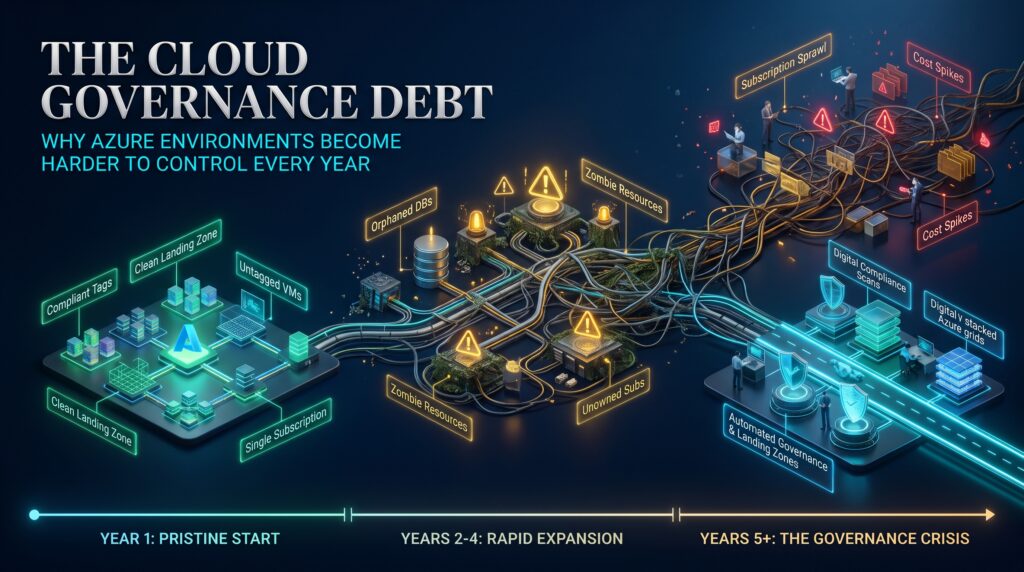


Cloud governance debt is the reason an Azure environment that felt tidy in its first year feels like a maze by its fifth. Every shortcut, exception and “we will clean it up later” decision adds a little more mess, until nobody is quite sure what exists, who owns it or what it is costing.
If you manage Microsoft Azure for an Australian business, you have probably felt this. Costs creep up, permissions multiply, security recommendations pile up and every change feels riskier than the last. Let us look at why cloud governance debt builds, what it costs, and how to pay it down with the right habits and the right Azure certification training.
What Is Cloud Governance Debt?
Governance is the set of rules, roles and guardrails that keep a cloud environment secure, compliant, affordable and organised. Cloud governance debt is what accumulates when those guardrails are skipped, delayed or allowed to decay.
It works like financial debt. You can borrow speed today by creating resources without naming standards, granting broad access or bypassing policy. The bill arrives later, with interest, in the form of higher costs, security gaps, audit headaches and slow, nervous change.
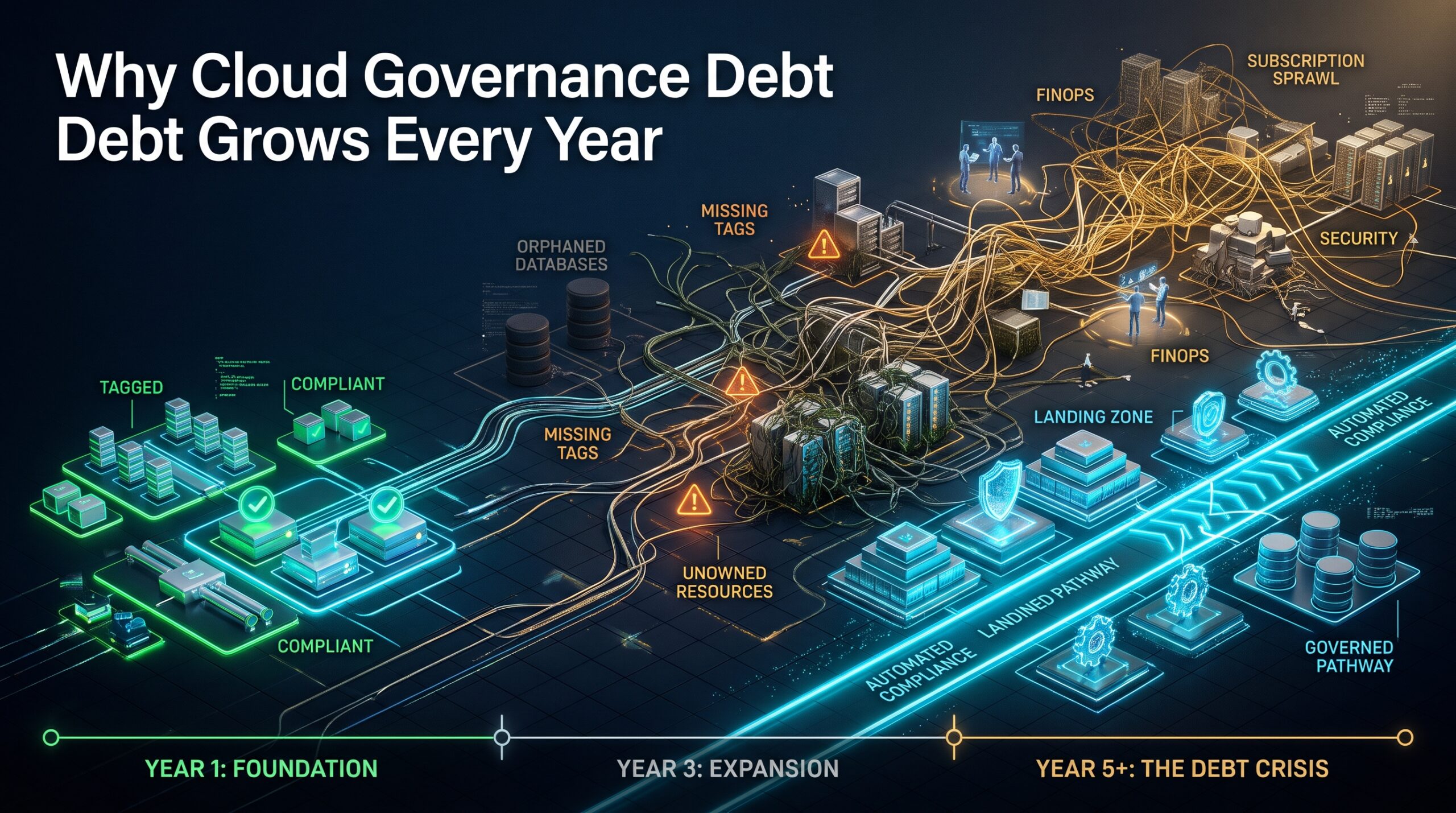
Why Cloud Governance Debt Grows Every Year
The debt rarely comes from one big mistake. It builds through normal, well-meaning decisions.
1. Speed beats structure at the start
Early projects need to launch quickly. Subscriptions are created ad hoc, resources are placed wherever is convenient and policies are “on the roadmap”. The first version works, and nobody wants to disturb it.
2. Subscriptions and resources sprawl
Each team, project and experiment adds more subscriptions, resource groups, virtual networks and storage accounts. Without management groups and a clear hierarchy, there is no simple way to apply rules consistently.
3. Tags and naming drift
Different teams use different naming patterns and tags, or none at all. Soon you cannot tell which resources belong to which application, owner or cost centre.
4. Access creeps upwards
People are given Owner or Contributor rights to unblock a task and keep them forever. Service principals and secrets are created and forgotten. Over time, role-based access control (RBAC) turns into a long list of unexplained permissions.
5. Policy exceptions never expire
An exception granted for one urgent project quietly becomes permanent. Our article on the Azure Policy drift problem explains how a compliant environment slowly stops being compliant.
6. Cost control is reactive
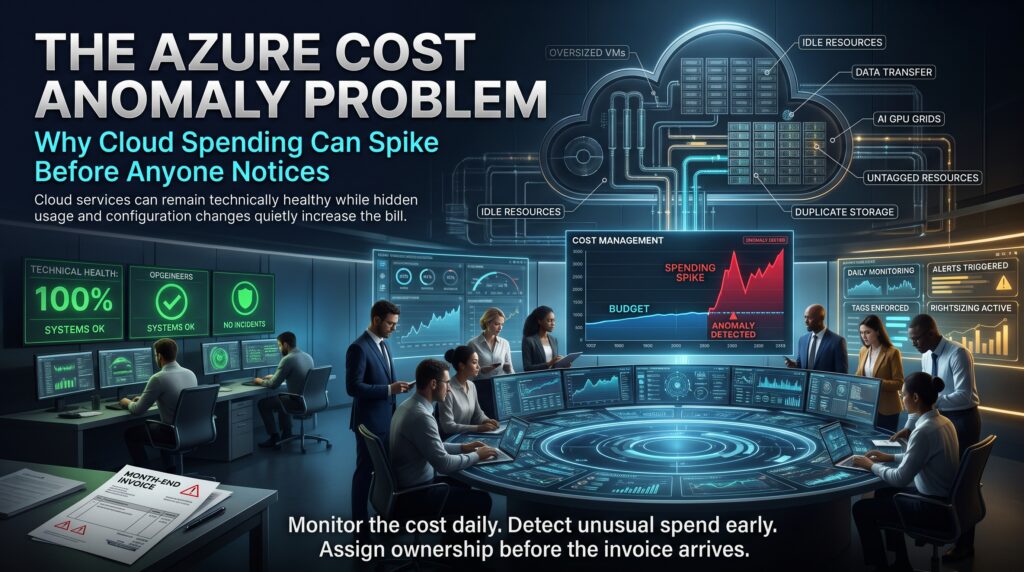
Budgets and alerts are added after the first surprise bill. Idle resources and oversized services stay on. See our look at the Azure cost anomaly problem to understand how spending can spike before anyone notices.
7. Manual changes bypass infrastructure as code
When people click through the portal to fix things, environments drift away from their templates. Documentation and automation stop matching reality.
8. People and platforms change
Engineers move on, mergers add new tenants, and Azure releases new services all the time. Knowledge walks out the door while the environment keeps getting more complex.
9. Cleaning up feels dangerous
The longer resources exist, the more dependencies hide around them. Teams are afraid to delete anything, so cloud governance debt compounds instead of shrinking.
The Real Cost of Cloud Governance Debt
- Rising and unpredictable bills. Orphaned disks, idle virtual machines and oversized services quietly consume budget.
- Security exposure. Over-privileged accounts, open networks and unaddressed recommendations widen your attack surface. The Australian Cyber Security Centre publishes guidance on securing cloud services for Australian organisations.
- Compliance and audit pain. Proving who has access to what, and where data lives, is hard without consistent structure.
- Slower delivery. Teams spend time hunting for resources, fixing deployment failures and waiting for approvals.
- Hard-to-explain surprises. Even valid deployments can fail on hidden limits, as described in our guide to the Azure quota exceeded problem.
- Key-person risk. Only a few people understand how the environment hangs together.
Warning Signs of Cloud Governance Debt
Check how many of these sound familiar:
- Nobody can list every subscription and who owns it.
- Many resources have no tags, or inconsistent ones.
- A large number of people hold Owner or Contributor roles.
- Security recommendations and policy non-compliance numbers keep rising.
- Cost reviews start with “what is this resource?”
- Changes are made in the portal first and documented later, if ever.
Three or more ticks mean the debt is already costing you.
How to Pay Down Cloud Governance Debt
You cannot fix everything in a week, and you should not try. Prioritise the biggest risks and build habits that stop new debt from forming.
Step 1: Get an honest baseline
Use Azure Resource Graph, Azure Advisor, Microsoft Defender for Cloud and Azure Cost Management to see what exists, what it costs and what is risky. Treat the output as your debt register.
Step 2: Design a management group and subscription structure
Organise subscriptions under management groups that reflect your organisation and your risk, such as production, non-production and shared services. Microsoft’s Cloud Adoption Framework describes landing zones and governance design in detail.
Step 3: Apply Azure Policy gradually
Start in audit mode to see how big the gap is, then move to enforcement for the rules that matter most. Azure Policy can require tags, restrict regions, enforce encryption and more. Give every exception an owner and an expiry date.
Step 4: Standardise naming and tagging
Agree a simple naming convention and a short list of mandatory tags, such as owner, application, environment and cost centre. Use policy to enforce them on new resources.
Step 5: Clean up identity and access
Apply least privilege with RBAC, use Microsoft Entra ID groups instead of individual assignments, and use Privileged Identity Management for time-limited elevated access. Review service principals and secrets on a schedule.
Step 6: Put cost governance in place
Set budgets, alerts and ownership for every subscription. The FinOps Foundation offers practical frameworks for managing cloud financial accountability.
Step 7: Move changes into code
Deploy through Bicep, Terraform and pipelines so changes are reviewed, repeatable and recorded. Treat portal changes as exceptions.
Step 8: Build a decommissioning habit
Tag resources with owners and review dates, identify anything unused and remove it safely, starting with low-risk items.
Step 9: Review against a recognised framework
The Azure Well-Architected Framework provides pillars for reliability, security, cost, operations and performance, and is a useful checklist for regular reviews.
Step 10: Assign ownership and a regular cadence
Name a cloud governance owner or small team, hold monthly reviews and keep a visible backlog of governance work. Pay down a little each sprint.
Why Skills Matter for Controlling Cloud Governance Debt
Governance depends on people who understand how Azure identity, networking, policy, security and cost controls fit together. Without those skills, teams either over-restrict and slow everyone down, or under-control and accumulate debt.
Structured training gives teams a shared language and tested practices. The AZ-900 Azure Fundamentals course covers cloud concepts, core services, security, privacy, compliance and governance, and suits beginners and non-technical staff. The AZ-104 Azure Administrator course builds the skills to implement, manage and monitor Azure infrastructure. For security teams, the AZ-500 Azure Security Technologies course covers identity, platform protection and data security.
Architects can explore the AZ-305 Azure Solutions Architect course to design governance, identity and scalable solutions, and delivery teams can look at AZ-400 Microsoft DevOps Solutions to bring automation and policy into pipelines. Browse everything on our Azure courses page.
Train in your city or online across Australia:
- Azure certification in Melbourne
- Azure certification in Sydney
- Azure certification in Brisbane
- Azure certification in Perth
- Azure certification in Adelaide
- Azure certification in Canberra
See all training locations, learn more about us, read the Azure FAQs, or browse more guides on our Azure blog.
Frequently Asked Questions About Cloud Governance Debt
What is cloud governance debt?
It is the build-up of missing or outdated rules, ownership, tagging, access controls and cost controls in a cloud environment, which makes it harder, riskier and costlier to manage over time.
Why do Azure environments get harder to control as they age?
More subscriptions, resources, users and exceptions are added each year, while knowledge and standards often fail to keep up. Complexity grows faster than control.
Where should I start fixing cloud governance debt in Azure?
Start with a baseline using Azure Resource Graph, Advisor, Defender for Cloud and Cost Management, then fix the biggest risks first, usually access, public exposure and unmanaged cost.
Does Azure Policy solve cloud governance debt on its own?
No. Policy is a powerful guardrail, but it needs good structure, clear ownership, regular review and trained people to keep it effective.
Which Azure certification helps with governance?
AZ-900 introduces governance concepts, AZ-104 covers day-to-day administration, AZ-500 focuses on security and AZ-305 covers design. The right choice depends on your role.
Final Thoughts: Make Governance a Habit, Not a Project
Cloud governance debt is not a sign that your team has failed. It is the natural result of fast-moving cloud adoption without enough structure. Get a baseline, organise your subscriptions, enforce a few key policies, tidy access, control cost, move changes into code and keep a regular rhythm of review. Pay down the debt a little at a time, and your Azure environment will get easier to control every year, not harder.
Ready to build your Azure skills? Call 1300 649 299 or contact our team to find the right Azure course in Melbourne, Sydney, Brisbane, Perth, Adelaide, Canberra or online.