


Skill security is quietly replacing job security as the thing that actually protects a career. A few decades ago, a permanent role at a solid employer felt like a safe harbour. You did good work, you stayed loyal, and the company looked after you. Today that deal is much weaker, and plenty of capable people have learned it the hard way through a restructure, an outsourced team or a role that simply disappeared.
If you work in IT in Melbourne, Sydney, Brisbane, Perth, Adelaide or Canberra, you’ve probably felt the shift already. The question has changed from “How long have you been with the company?” to “What can you do right now, and can you prove it?” This guide explains why skill security is taking over, what it looks like in practice, and how a structured Microsoft Azure certification pathway can help you build it deliberately.
What Job Security Used to Mean
Traditional job security rested on three assumptions. First, that employers wanted long-term loyalty. Second, that a role would stay roughly the same for years. Third, that experience in one company’s way of working would carry you through. For many people, all three were true for a long time.
None of them is reliable now. Companies reorganise often, tools change within a few years, and “ten years of experience” can quietly turn out to be one year repeated ten times. Job security still exists in pockets, but it depends on factors you don’t control: budgets, leadership decisions and market swings.
Why Job Security Is Being Replaced by Skill Security
Skill security means your safety comes from what you can do, not from where you sit. Because your abilities travel with you, they hold their value when a role or employer changes. Several forces are pushing this shift along.
Technology moves faster than job titles
Cloud computing is the obvious example. Work that once needed a server room and a specialist team now runs on platforms such as Microsoft Azure. Job descriptions struggle to keep up, so employers increasingly hire for specific capabilities rather than fixed titles.
Employers hire for outcomes, not tenure
Hiring managers want evidence that you can solve their problem this quarter. A current, verifiable credential and a few hands-on projects often answer that better than a long list of past employers. That doesn’t make experience worthless. It means experience works best when it’s backed by current skills.
Careers are longer than employers
Most people will work for many organisations across a career that may last four decades or more. No single employer can guarantee that long. The only constant across all those roles is you, and the skills you’ve kept sharp.
Restructures and automation reshape roles
Reports such as the World Economic Forum’s Future of Jobs research highlight how technology and automation are changing the skills employers need. You can also explore local demand on Jobs and Skills Australia. The pattern is consistent: tasks change first, then roles, then whole teams. People with portable skills adapt. People tied to one narrow task get squeezed.
What Skill Security Looks Like in Practice
It isn’t a slogan, and it isn’t about collecting certificates for their own sake. Real skill security has four features:
- Your skills apply across employers, industries and cities, not just inside one company’s tools.
- You keep learning, so what you know matches what the market asks for today.
- You can show evidence, such as a recognised credential, lab work or a project you can talk through.
- In demand. You’ve picked a field where organisations are actively hiring and investing.
Picture two systems administrators in Adelaide with similar experience. One has spent years maintaining the same on-premises setup and hasn’t touched the cloud. The other has been steadily learning Azure and holds a recognised credential. When the company announces a move to the cloud, the second person is asked to lead it. The first is asked about their notice period. That’s an illustration, not a statistic, but anyone who has worked in IT will recognise the pattern.
Skill Security in the Cloud Era
Cloud skills are one of the clearest routes to skill security, because organisations across every industry are moving workloads to platforms like Azure. Roles such as Azure Administrator, Cloud Engineer, Azure Developer, Security Engineer, Data Engineer and Solutions Architect all depend on practical cloud knowledge. Microsoft’s certification programme on Microsoft Learn gives these skills a recognised, role-based structure, which makes them easy for employers to understand.
Delay has a price, too. Our articles on the cost of waiting to learn Azure and the cloud skills gap explain how small postponements add up into a real career disadvantage.
An Azure Roadmap for Building Skill Security
You don’t need to collect every certification. Choose the path that matches where you want to be in two or three years. Our Azure certification roadmap and certification comparison guide help you decide, and here’s the short version.
Start with the foundations
The AZ-900 Azure Fundamentals course covers cloud concepts, core Azure services, pricing, security and governance. It suits beginners, career changers, students and non-technical staff who need cloud awareness. Browse all fundamental courses to see the options.
Build job-ready administration skills
Once you’re comfortable with the basics, the AZ-104 Azure Administrator course teaches you to implement, manage and monitor Azure infrastructure. It’s a popular step for system administrators and support engineers moving into the cloud.
Add security
Security skills tend to stay in demand whatever else changes. The AZ-500 Azure Security Technologies course focuses on identity and access, platform protection, data and application security, and responding to threats. If you’d like a wider view of the field, see this cybersecurity training course.
Move into design and architecture
Experienced professionals can progress to the AZ-305 Azure Solutions Architect course, which covers designing cloud infrastructure, governance, identity and scalable architectures.
Specialise in development, DevOps or networking
Developers can look at the AZ-204 Azure Developer course, DevOps-minded engineers at the AZ-400 DevOps Solutions course, and network specialists at the AZ-700 Azure Networking course. For a broader overview of Azure learning options, the Azure courses at Logitrain are another place to look.
How to Build Skill Security Without Burning Out

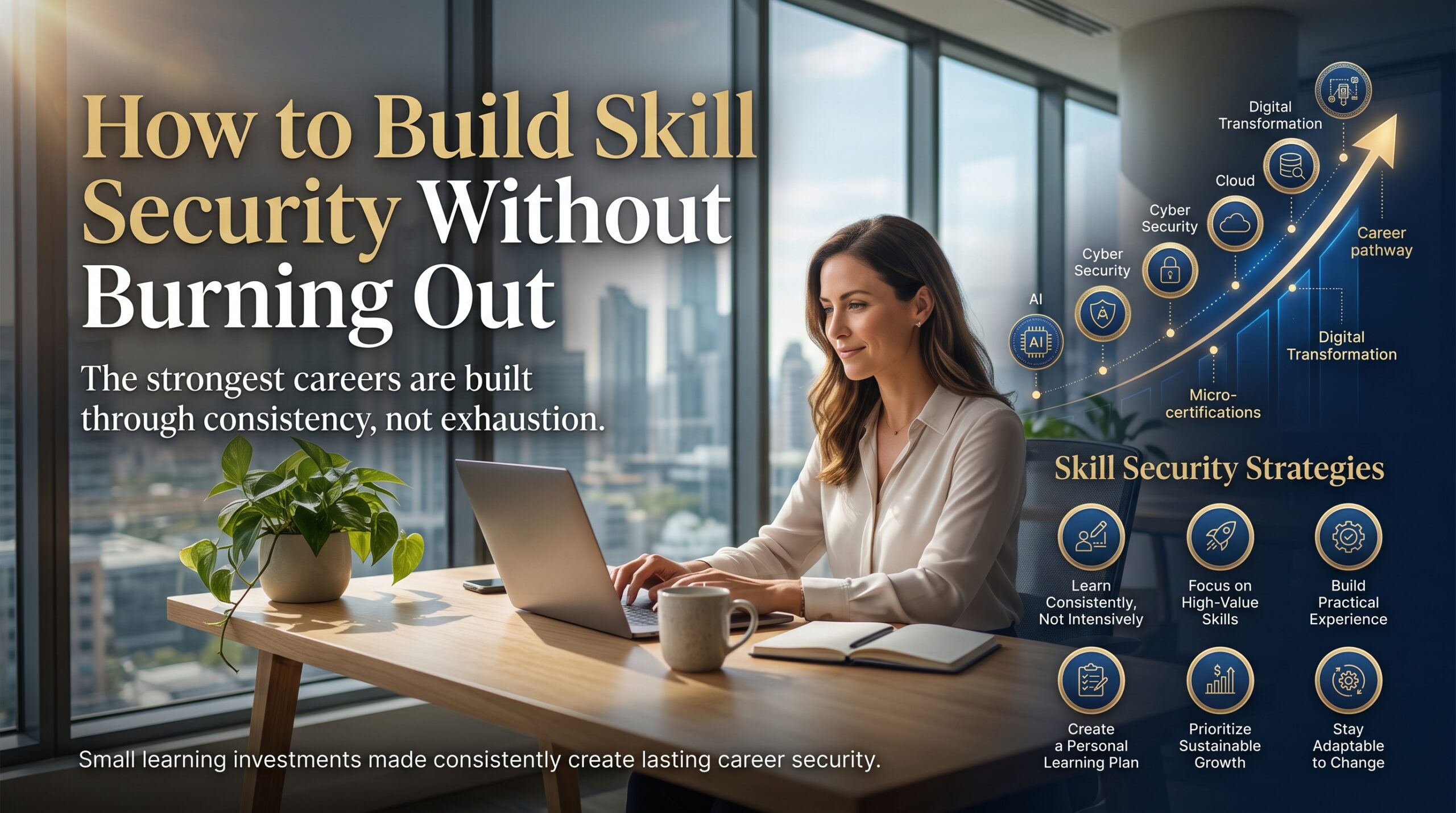
Building skill security shouldn’t mean giving up your evenings for a year. Small, steady steps work better than dramatic bursts.
1. Audit what you actually do
List the tasks you perform and mark which ones could be automated, outsourced or replaced by a tool within five years. Be honest. The tasks you can’t automate are your base. The ones you can are your warning.
2. Pick one direction
Trying to learn everything is the fastest route to learning nothing. Choose a single track, such as administration, security or development, and commit to it for a few months.
3. Learn by doing
Reading about cloud is not the same as building in it. Hands-on labs turn knowledge into something you can use at work and discuss in an interview. Real practice is the quickest way to make skill security feel solid.
4. Prove it
A recognised credential gives employers a clear signal. Pair it with a small project you can explain, and you have evidence rather than claims. Microsoft’s role-based certifications are generally kept current through renewal, so check Microsoft Learn for the latest rules on each one.
5. Put learning in your calendar
Two focused hours a week beats a good intention. Treat it like a standing meeting with your future self.
Skill Security for Employers and Teams
This isn’t only an individual issue. Organisations that invest in skill security for their teams keep knowledge in-house, reduce hiring pressure and adapt faster to change. Teams that learn together also share a common language for cloud work, which makes projects smoother. We offer flexible delivery, including live online and in-house training for groups, so you can build capability without pulling people away for long. You can contact our team to discuss a plan for your staff.
Related Reading on Career Resilience
If this topic resonates, these articles go deeper on the same theme:
- Why adaptability is replacing experience as the most valuable career asset.
- The relevance gap: why some professionals stay in demand while others become easy to replace.
- Legacy IT skills: the career gravity problem that keeps pulling people back.
- The comfort zone tax: what avoiding cloud skills really costs your career.
A Five-Minute Skill Security Check
Answer honestly. Each “no” shows where you can strengthen your position.
- Could you get a similar role elsewhere within a few months?
- Have you learned something significant and job-relevant in the last twelve months?
- Do you hold a current credential that employers recognise?
- Can you describe a hands-on project that shows what you can do?
- Is your main skill growing in demand, or slowly being automated?
Frequently Asked Questions
What is skill security?
Skill security is the confidence that comes from holding current, in-demand and provable skills that you can take to any employer. It replaces the old idea that a permanent position alone keeps you safe.
Does this mean job security no longer matters?
Not at all. A stable job is still valuable. The point is that you shouldn’t rely on it as your only protection. Skill security gives you options if the job changes.
Which Azure certification should I start with?
Beginners and career changers usually start with AZ-900, then move to a role-based certification such as AZ-104, AZ-500 or AZ-305 depending on their goals. Our FAQ page answers more questions about choosing a path.
Do I need IT experience to start?
Not for the fundamentals. AZ-900 is designed for beginners and non-technical professionals. Associate and expert-level courses suit people with some background in IT, networking, development, security or systems administration.
Make Skill Security Your Career Plan
Nobody can promise you a job for life any more. What you can build is the ability to find your next opportunity quickly, and to be the person an employer is relieved to hire. That’s what skill security really offers: calm in a changing market.
Ready to start? Explore our full list of Azure certifications, read more on the Azure training blog, or get in touch and we’ll help you choose a pathway that fits your goals.