

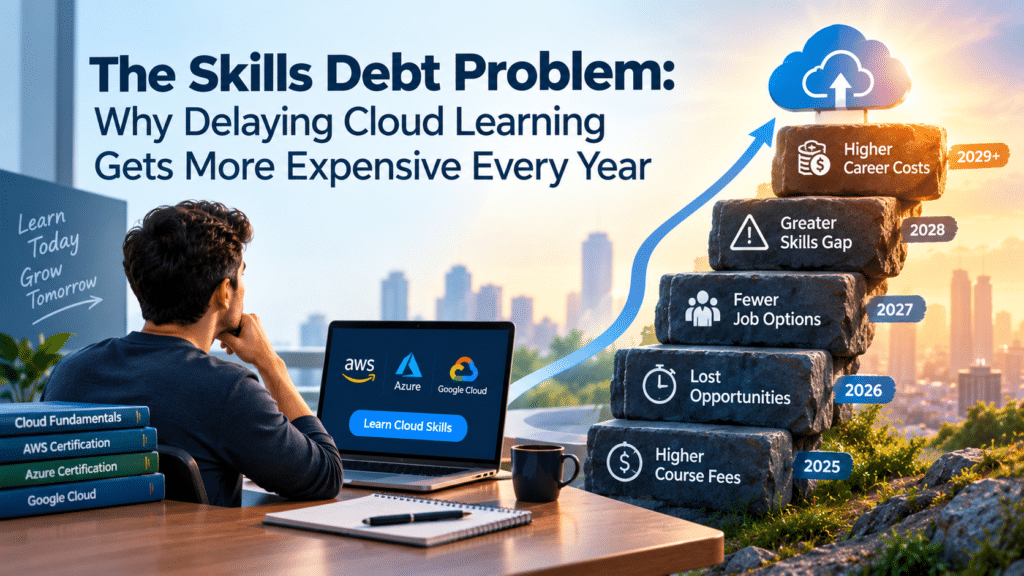
The cost of waiting to learn Azure rarely shows up as a single bill. It arrives quietly, as a job you were not shortlisted for, a project you were not asked to join, a pay conversation that went nowhere. Every year you postpone cloud learning, the platform grows, employers expect more and the gap between you and the people who started earlier gets wider. That growing gap is what we call cloud skills debt, and like any debt, it compounds.
This guide explains how cloud skills debt works, seven ways the cost of waiting to learn Azure increases each year, and a practical plan to start paying it down without quitting your job or burning out. You will also find an Azure certification pathway, city-by-city insight for Sydney, Melbourne, Brisbane, Perth, Adelaide and Canberra, and the training that supports each step.
What Is Cloud Skills Debt?
Software teams talk about technical debt: the shortcuts you take today that make tomorrow’s work slower and more expensive. Cloud skills debt is the career version. Each month you put off learning Azure, you add to a backlog of knowledge you will eventually need, and the longer you wait, the more you have to catch up on at once.
Unlike technical debt, you cannot refactor your way out of it. The only way to reduce it is to learn, and the learning curve is steeper the further behind you fall. That is why the cost of waiting to learn Azure feels small in year one and uncomfortable by year three.
The good news is that the debt is entirely repayable. Most professionals can build a solid, employable Azure foundation in a few months of structured effort, and every month you start earlier is a month of compounding in your favour.
The Real Cost of Waiting to Learn Azure
When people think about delay, they usually think about missed salary. That is only one piece. The full cost of waiting to learn Azure is made up of several parts that stack on top of each other.
- Opportunity cost: roles, projects and promotions that go to colleagues who already have cloud skills.
- Time cost: a bigger body of knowledge to learn later, often while carrying more responsibility and less spare time.
- Relevance cost: existing on-premises skills slowly lose market value as more workloads move to the cloud.
- Confidence cost: the longer you wait, the more daunting cloud feels, which makes starting even harder.
Because these costs overlap, the total is larger than the sum of the parts. It is also invisible, which is why so many capable IT professionals underestimate it.
7 Ways the Cost of Waiting to Learn Azure Grows Every Year
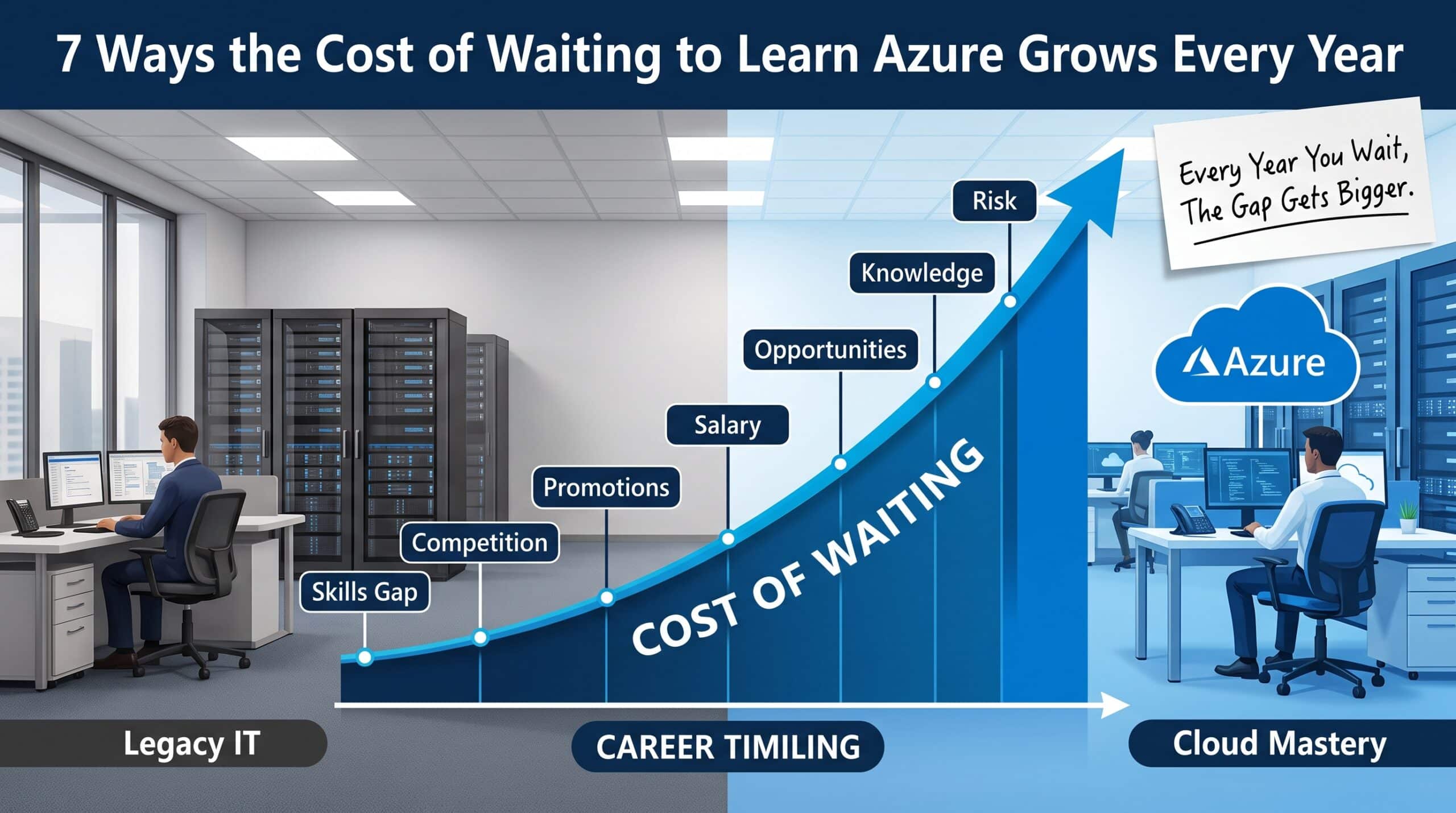
1. The Azure platform keeps expanding
Microsoft adds services, features and renames at a steady pace. Azure Active Directory became Microsoft Entra ID, AI services expanded rapidly with Azure OpenAI, and governance and security tooling keeps maturing. Someone who started two years ago learned this gradually. Someone who starts later faces the whole accumulated platform at once.
2. Employers keep raising the baseline
Not long ago, cloud knowledge was a bonus on a job ad. Now many infrastructure, security, data and support roles assume at least basic Azure literacy. The bar for “nice to have” keeps moving up, so the cost of waiting to learn Azure rises as the minimum expectation rises.
3. Newer professionals are starting cloud-first
A growing share of people entering IT today learn cloud from day one rather than adding it later. They are not burdened by legacy habits, and they are often comfortable with infrastructure as code, automation and managed services. If you are competing for the same roles, their head start becomes your problem.
4. Your existing skills depreciate
Experience with on-premises servers, networking and virtualisation is still valuable, but its market premium shrinks as more systems migrate. Waiting does not preserve those skills. It slowly erodes their value, while the cloud skills that would extend them stay unlearned.
5. You miss the migration and modernisation windows
Organisations run cloud migrations, security uplifts and AI initiatives in waves. Professionals who already know Azure get pulled into these projects, and the experience compounds. If you wait, you may find the big window has closed and the best learning-on-the-job opportunities went to someone else.
6. Exams and expectations keep moving
Microsoft updates its role-based certifications regularly to reflect platform changes, and most need annual renewal through a free online assessment. That is good for keeping skills current, but it also means the study material you would have used last year may already be outdated. Starting sooner means less relearning and more steady progress.
7. Your learning curve gets steeper as life gets busier
Early in a career there is usually more time and flexibility. Later come promotions, families, larger workloads and less energy in the evening. The same Azure course that takes ten calm weeks now can take much longer when squeezed around a demanding job. Delay raises the cost of waiting to learn Azure in plain hours, too.
Start Now vs Wait Two Years: A Side-by-Side View
The table below shows how the same professional could end up in two very different positions, based only on when they start.
| Area | Start learning Azure now | Wait two more years |
| Job options | Eligible for cloud roles as they open | Missed several hiring cycles |
| Learning pace | Steady, one certification at a time | Rushed catch-up across more material |
| Platform knowledge | Learned gradually as Azure evolves | Must absorb two years of change at once |
| Project experience | Hands-on from migrations and upgrades | Fewer opportunities to practise on real work |
| Negotiating power | Can point to cloud results and credentials | Pay conversations rest on older skills |
| Confidence | Builds with each milestone | Gap feels larger and more intimidating |
None of these differences come from talent. They come from timing, which is the one thing you can change today.
An Illustrative Look at the Cost of Waiting to Learn Azure
Numbers help make the point, but they depend entirely on your situation. As a simple illustration, imagine that adding solid Azure skills could lift your earning potential by an assumed $8,000 a year. This is an example for thinking, not a promise or a salary benchmark. Check current market data for your role and city.
| Delay | Assumed uplift not earned | Other likely costs |
| 1 year | $8,000 | One hiring cycle missed, more material to learn |
| 2 years | $16,000 | Skills gap becomes visible in interviews |
| 3 years | $24,000 | Competing with cloud-first candidates for the same roles |
| 5 years | $40,000 | Career options narrow, reskilling feels urgent |
Change the uplift to any number that suits your role and the pattern holds. The cost of waiting to learn Azure grows in a straight line at best, and often faster once opportunity and relevance costs are included.
Where to Start: A Practical Azure Certification Pathway
You do not need to learn everything at once. Pick a direction, build a foundation and add depth over time.
| Stage | Certification | Who it suits |
| Foundation | AZ-900 Azure Fundamentals | Anyone new to cloud, including non-technical roles |
| Administration | AZ-104 Azure Administrator | IT support, sysadmins and infrastructure staff |
| Security | AZ-500 Azure Security Engineer | Security analysts and engineers |
| Architecture | AZ-305 Azure Solutions Architect | Experienced engineers moving to design roles |
| Development | AZ-204 Azure Developer | Developers building cloud applications |
| Data and AI | DP-900, AI-900 and AI-102 | Data professionals and AI-curious technologists |
Most people start with the Azure Fundamentals AZ-900 certification and then move to an associate-level role-based exam. Starting with the right first step keeps the learning manageable and the momentum high.
A 90-Day Plan to Start Paying Down Your Cloud Skills Debt
You do not need to quit your job or study all night. Small, consistent steps work well.
| Phase | Focus | What to do |
| Days 1 to 30 | Foundations | Create a free Azure account, learn core concepts and complete the AZ-900 study path. Schedule your exam date. |
| Days 31 to 60 | Hands-on practice | Build small labs: a virtual machine, storage account, simple network and basic access controls. Note what you learn. |
| Days 61 to 90 | Certify and apply | Sit AZ-900 and choose your next certification. Bring one Azure idea to your manager or team at work. |
After 90 days you will have a recognised credential, practical lab experience and a clear next step. That is a real, visible reduction in the cost of waiting to learn Azure.
Why the Cost of Waiting to Learn Azure Differs Across Australian Cities
The principle is universal, but local demand shapes how quickly delay hurts.
- Sydney: banking, financial services and consulting run large cloud programs, and cloud literacy is close to a baseline expectation.
- Melbourne: health, retail and technology firms are modernising rapidly, with strong demand for infrastructure and data skills.
- Brisbane and the Gold Coast: government, infrastructure and managed services growth is creating more cloud roles each year.
- Perth: resources and energy companies are moving operational and corporate workloads to the cloud, with a need for secure, reliable engineers.
- Adelaide: defence, health and advanced manufacturing sectors are building cloud capability with an emphasis on security and compliance.
- Canberra: federal agencies are expanding cloud use under strict governance, which favours professionals with security-focused Azure skills.
Wherever you work, the cost of waiting to learn Azure follows the same curve: small at first, then steadily larger.
Azure Courses That Help You Start Now
Structured training saves time, keeps you focused on exam objectives and gives employers a recognised signal. These are the pathways Australian professionals ask about most.
- Azure Fundamentals (AZ-900): the best first step for most people. Explore our Azure certification courses and the dedicated AZ-900 site.
- Azure Administrator (AZ-104) and Security Engineer (AZ-500): associate and specialty pathways for infrastructure and security roles. See cyber security certifications for the security track.
- Azure Data and AI pathways: for data professionals building cloud analytics skills. Visit data analytics courses.
- Wider IT training: browse the full catalogue at Logitrain.
Not sure which certification suits your background? Our team can help you map a pathway to your current role and goals.
Quick Self-Audit: How Much Cloud Skills Debt Do You Carry?
Answer honestly. Each “no” shows where your debt is building.
- Can you explain the core Azure services and how they fit together?
- Do you hold at least one current Azure certification?
- Have you built something hands-on in Azure in the last six months?
- Do you understand how Microsoft Entra ID, networking and security basics work?
- Do you have a dated plan for your next Azure milestone?
- Could you speak confidently about Azure in a job interview today?
If you answered no to three or more, the cost of waiting to learn Azure is already accruing, and the 90-day plan above is a sensible place to start.
Frequently Asked Questions
What is the cost of waiting to learn Azure?
It is the combined effect of missed roles, slower progression, outdated skills and a steeper learning curve that builds up each year you delay. It is rarely one big loss. It compounds quietly over time.
Is it too late to learn Azure?
No. Azure is still expanding, and there is steady demand for professionals who can work with it. Starting now is always cheaper than starting later, even if you feel behind.
How long does it take to learn Azure?
Most people can prepare for AZ-900 in a few weeks and build a solid associate-level skill set in a few months, depending on experience and study time. Hands-on practice speeds things up considerably.
Which Azure certification should I start with?
AZ-900 Azure Fundamentals suits most beginners, including non-technical staff. If you already have strong IT experience, you can move directly to AZ-104 or AZ-500 depending on your role.
Do Azure certifications expire?
Microsoft role-based certifications generally need to be renewed each year through a free online assessment, while fundamentals certifications typically do not expire. Check the Microsoft Learn page for your exam for current details.
Pay Down Your Cloud Skills Debt Before It Grows
The cost of waiting to learn Azure is not a reason to panic. It is a reason to act, because every month you start earlier works in your favour. A foundation certification, a few hands-on labs and a clear plan are enough to change your trajectory.
Ready to begin? Explore our Azure certification courses, start with the AZ-900 Fundamentals pathway, or browse the full range at Logitrain.